A senior developer combines strong technical expertise with independence and mentoring. The role centers on producing high-quality technical work, handling complex projects, contributing to technical planning, and helping teammates succeed. section 2.1.2
Common expectations include:
- More than three years of experience, although organizations set different thresholds. section 2.1.2
- Experience with complex projects and successfully implemented, high-quality features. section 2.1.2
- Ability to navigate every phase of the Software Development Lifecycle and self-manage tasks and projects. section 2.1.2
- Willingness to mentor junior developers, communicate technical opinions, and speak up in development meetings. section 2.1.2
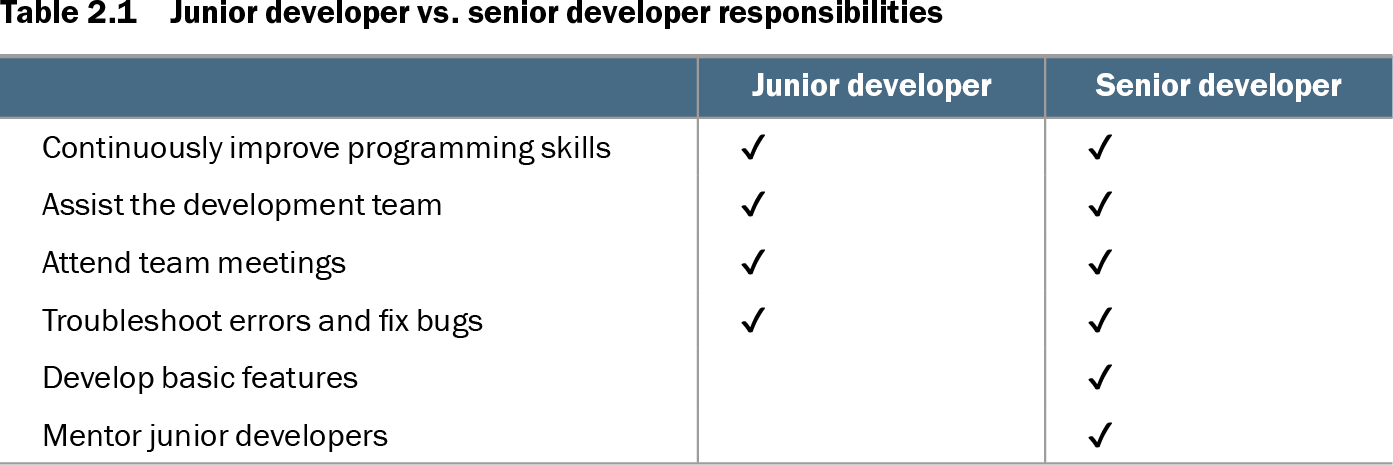
Senior and junior developers share several responsibilities: improving programming skills, assisting the team, attending meetings, troubleshooting errors, fixing bugs, and developing features. Senior developers additionally mentor junior developers and apply higher-level technical concepts to new features. section 2.1.2
Table 2.1 Junior developer vs. senior developer responsibilities (view table figure)
| Junior developer |
Senior developer |
|
|---|---|---|
| Continuously improve programming skills |
✓ |
✓ |
| Assist the development team |
✓ |
✓ |
| Attend team meetings |
✓ |
✓ |
| Troubleshoot errors and fix bugs |
✓ |
✓ |
| Develop basic features |
✓ |
|
| Mentor junior developers |
✓ |
Use the responsibility comparison to distinguish shared development work from the senior developer’s additional mentoring responsibility. section 2.1.2
From technical contributor to mentor
A developer may spend early years improving programming skills and fixing assigned bugs, then take on complex features, guide peers toward useful resources, and contribute opinions during technical planning. Promotion is not automatic; the developer may need to ask for it and demonstrate readiness. section 2.1.2
The usual progression is junior developer, senior developer, then lead developer, but organizations may insert a mid-level role or vary responsibilities. Lead developers add broader leadership, coordination, decision-making, and stakeholder responsibilities beyond senior technical work. section 2.5 section 1.0