A sensor detects a physical condition and turns it into a measurement a digital twin can use. Temperature, vibration, water flow, and human activity reveal how a system behaves now, rather than how its design model says it should behave. The goal is not to collect every possible reading: deploy sensors that support a specific decision, whether monitoring a condition, predicting a failure, or adjusting a system. section 3.0 section 3.1
A measurement reaches a digital twin through a signal chain:
- A physical change affects a sensing element, which converts it into an electrical signal. section 3.1.1
- Electronics amplify and filter the signal; an analog-to-digital converter samples it into digital values. section 3.1.1
- Processing applies corrections and filtering before formatted data is transmitted. A thermistor, for example, changes resistance with temperature; calibration converts its sampled signal into a temperature reading. section 3.1.1
Listing 3.1 Analog-to-digital conversion quantizing a voltage signal
def adc_read(voltage, bits=10, vref=3.3):  #1
  max_val = 2**bits - 1
  return int((voltage / vref) * max_val)  #2

def to_moisture(adc_value, dry=850, wet=400):
  if adc_value >= dry: return 0
  if adc_value <= wet: return 100
  return 100 * (dry - adc_value) / (dry - wet)

print(f"{to_moisture(adc_read(1.5)):5.1f}%")
The Python listing converts voltage into a 10-bit ADC value, then maps that value between dry and wet calibration readings to produce a moisture percentage. Conversion and calibration are distinct steps: a raw digital value is not yet the measurement the twin needs. section 3.1.1
Conversion also limits what can be observed. In a simplified example, sampling a changing voltage once per second with a 2-bit converter misses a brief drop. If that drop matters to the decision, the sensing and conversion characteristics must change. section 3.1.1
Select and deploy sensors by working backward from the decision:
- Identify the failure or outcome of interest, then the parameter that signals it earliest. Establish its operating range, rate of change, needed history, and acceptable update delay. section 3.2.1
- Match accuracy, sampling rate, and latency to that parameter—not to the highest available specification. Check placement, weather or industrial exposure, access, mounting, and power. section 3.2.2
- Before purchase, verify network compatibility, platform support, payload format, decoding work, and calibration needs. A working device is of little use if its readings cannot reach the twin. section 3.2.3
A home sensing network
Energy and water decisions call for different measurements: electricity use, water flow, rainwater storage, occupancy, temperature, and humidity. Locations and power availability shape the network. Battery-powered sensors use LoRaWAN, while devices near outlets use Wi-Fi and send readings to a common message broker. An electricity-meter pulse counter instead syncs over BLE to a phone, so its data must be exported manually. section 3.2.4 section 3.3.3
Figure 3.6 A hybrid sensor network that uses LoRaWAN and Wi-Fi to send electronic sensor readings to a common message broker
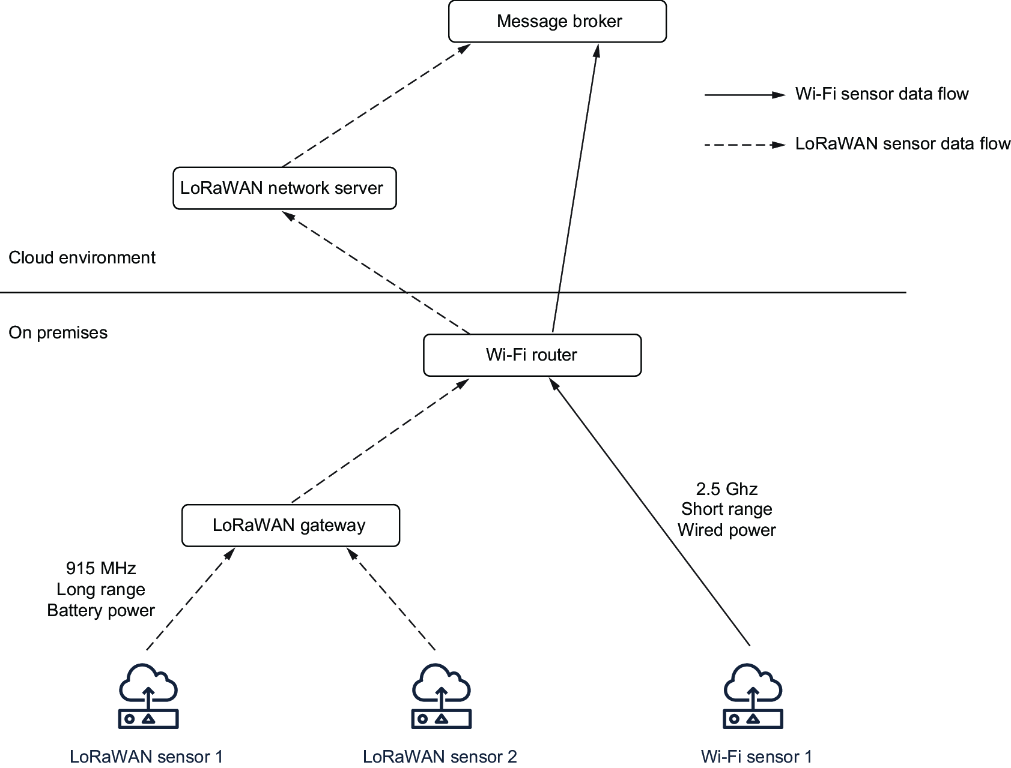
The hybrid-network diagram shows LoRaWAN and Wi-Fi readings converging at a message broker. Sensor placement, power, and existing infrastructure can justify more than one communication path. section 3.3.3
Electronic sensing need not cover every gap. A manual pool test can be more practical than an expensive automated chemistry sensor, and an optical meter sensor can provide finer-grained electricity readings than a delayed utility portal—though phone-only transfer prevents automatic ingestion. Once readings arrive, they still need decoding, standardization, and processing. At scale, plan for monitoring, firmware management, and calibration. section 3.4.2 section 3.8
