Raw data is data in its original, unprocessed state. It precedes business-specific modeling, analytical transformations, and the conversion of data into information. section 3.1
Use raw data as the starting point for practical analytical decisions:
- Select it when the problem requires detailed measurements rather than high-level summaries or estimated values. section 8.3
- Inspect what each row represents, then check geographic and time coverage before aggregating or transforming it. section 8.3
- Move recurring business rules into intermediate data models instead of repeating filters or definitions during analysis. section 3.1
Road traffic analysis
To study cycling traffic, choose raw count data instead of area-level annual summaries or estimated measurements. Before analysis, determine whether each row represents a location-day and whether locations and dates are consistently covered. section 8.3
Figure 3.1 Data modeling and analysis as mapped to the data science process
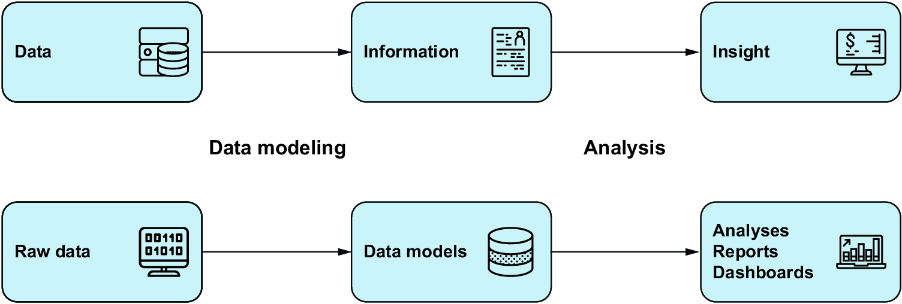
Trace how raw data becomes modeled information and then supports analysis. section 3.1
