A sensor is a robot’s input device: it measures a physical quantity and exposes data representing that measurement to robot software. Sensors connect the physical environment to computation, while sensing software gives their raw output meaning. section 1.2.2 section 1.2.3
Common sensor input-output pairs include:
- A temperature sensor converts heat into a temperature expressed in kelvin, Celsius, or Fahrenheit. section 1.2.2
- A camera sensor converts light into a two-dimensional array of spatial light intensities. section 1.2.2
- A joint position sensor converts relative body rotation into angular measurements such as increments, degrees, or radians. section 1.2.2
- Sensor hardware can contain firmware that processes measurements; users generally interact with it as a black box through a known API. section 1.2.2
Measurements are imperfect: sensor noise makes values fluctuate around the real value, and every sensor has limited accuracy. Accuracy, cost, and size therefore create practical tradeoffs. Hardware physics is usually hidden behind the sensor interface; processing belongs in sensing when it extracts information without considering the robot’s objectives. section 1.2.2 section 1.2.3
Figure 1.1 The conceptual structure of a robot system forms a continuous loop across six essential parts. Sensors acquire raw data from the environment, which sensing processes into meaningful information. Planning uses this information to calculate the next action, which acting translates into physical commands for actuators that ultimately alter the environment.
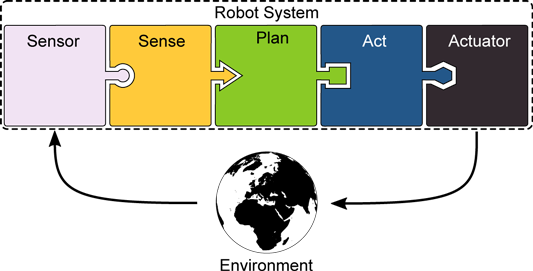
Trace the sensor’s role in the continuous robot loop: the environment produces raw data, sensing interprets it, planning selects an action, and acting drives actuators that change the environment. section 1.2
ReBo(o)t
A minimal robot for automatically rebooting a crashed computer uses one light sensor and one actuator. Its simple planning algorithm responds to the sensor input, illustrating how a physical measurement can participate in a complete robot system. section 3.1


