Customer sentiment is the overall favorable, unfavorable, or neutral attitude expressed about a product, service, or experience. Star ratings provide a quick satisfaction signal; review analysis reveals the reasons behind it, such as praise for battery life or complaints about service. section 5.3.1 section 6.2.1
Use sentiment analysis at different levels of detail:
- Classify text as positive, negative, or neutral for a broad view of customer reception. section 6.2.1
- Detect emotions such as happiness, anger, fear, or disappointment when urgency and customer reaction matter. section 6.2.1
- Apply aspect-based sentiment analysis to connect opinions with particular product features or service attributes. section 6.2.1
- Combine sentiment proportions with frequently mentioned topics to identify strengths, weaknesses, changing preferences, and common use cases. section 5.3.1
Comparing review sentiment by product group
Aggregate reviews into positive and negative categories, group them by product category, and compare counts or ratios. A category with a high negative-review ratio becomes a preliminary diagnostic signal for product improvement, marketing, or operational attention. section 4.4
Figure 4.4 Grouped bar plot showing aggregated review score counts by product categories aggregated into product groups, with a line indicating the ratio of negative reviews to positive
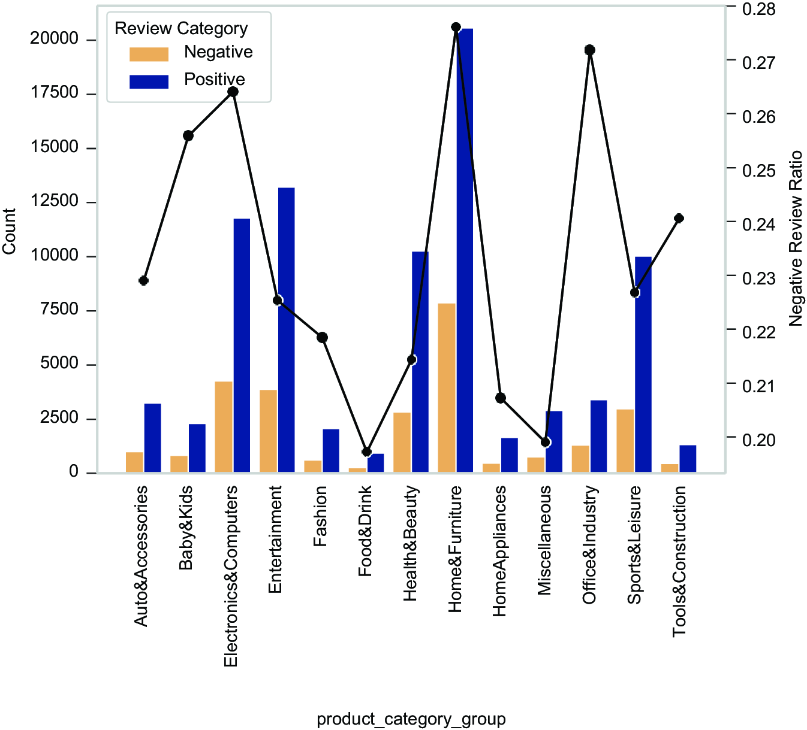
Inspect a grouped bar chart of positive and negative review counts alongside a line showing the negative-review ratio. section 4.4
