Deploying a microservice application means coordinating many independently deployable services, potentially built with different languages and frameworks. Manual deployment in language-specific packages such as WAR files does not scale; automated deployment infrastructure is needed. section 7.6.2
Deployment approaches include:
- Language-specific packages, such as WAR files, deployed through a traditional process. section 7.6.2
- Services deployed as virtual machines or containers. section 7.6.2
- Serverless platforms that run uploaded service code. section 7.6.2
- Automated, self-service deployment platforms; GitOps platforms use Git configuration to define desired state and automate changes. section 7.6.2
Figure 7.14 Several patterns for deploying microservices. The traditional approach is to deploy services in a language-specific packaging format. There are two modern approaches to deploying services. The first deploys services as VM or containers. The second is the serverless approach. You simply upload the service’s code and the serverless platform runs it. You should use a service deployment platform, which is an automated, self-service platform for deploying and managing services.
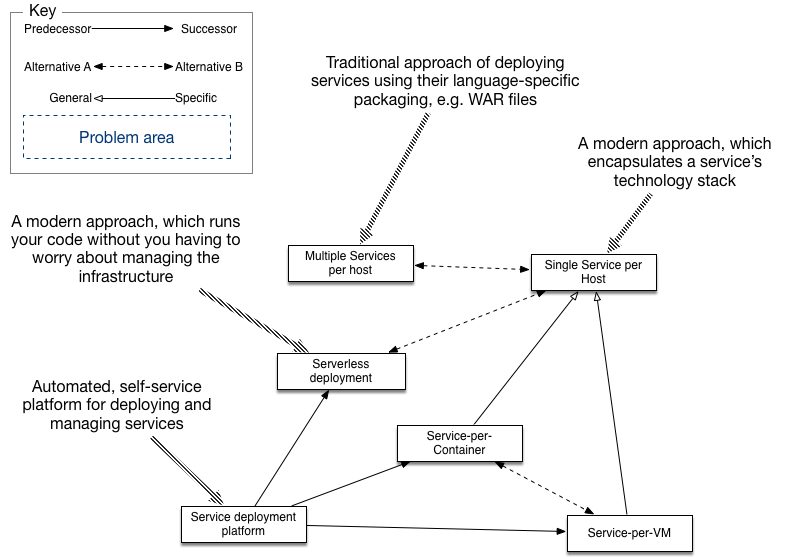
Compare traditional packaging, VM or container deployment, serverless execution, and the role of an automated deployment platform. section 7.6.2
