A service-level indicator (SLI) is a quantitative measurement of how a service is experienced by its customer. Every SLI is a metric, but only service-relevant metrics qualify as SLIs. Common SLIs measure availability, error rate, latency, successful or failed jobs, and throughput. section 10.1.2
Choose the measurement according to the service being evaluated:
- Measure uptime, availability, reachability, error rate, or response duration for synchronous services. section 10.1.2
- Measure successfully completed or failed jobs for asynchronous services such as batch workloads. section 10.1.1 section 10.1.2
- Measure throughput when the relevant customer experience concerns sustained transaction capacity. section 10.1.2
SLIs provide the measurements used to assess service-level objectives (SLOs), while SLOs express goals for the service team and service-level agreements (SLAs) communicate contractual commitments to customers. Teams can aggregate SLI values, calculate percentiles, establish dashboards and alerts, and report whether an SLO was met. Thresholds require judgment: stricter reliability goals demand more effort, and a dependent service can limit the reliability of the overall request path. section 10.1 section 10.1.3 section 10.4
Chat2Much API availability
For the Chat2Much API, product and engineering establish SLIs for availability, request count, and errors to track a monthly availability SLO. A load test observes 1,000,000 requests and 6,942 failures; allowing headroom by rounding failures to 7,000 supports a realistic 99% availability commitment. Production dashboards and alerts then track the SLIs and report performance against the SLO. section 10.2.1
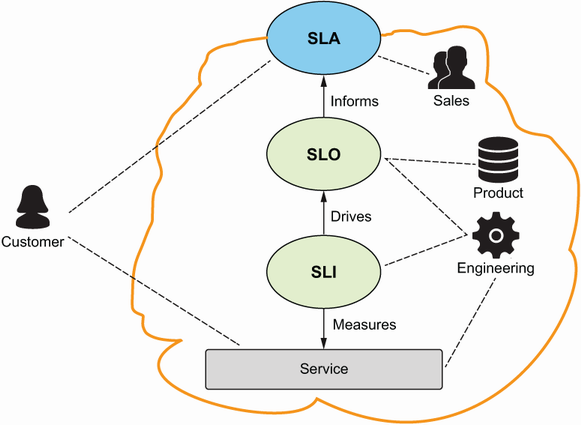
Use the relationship diagram to distinguish measurements from organizational goals and contractual commitments. section 10.1


