A service level objective (SLO) is a target value or range for a service reliability or performance measure over a defined period. Teams compare service level indicators (SLIs), such as error rate, with the SLO to determine whether the goal was met. section 2.4.4 section 10.1.3
SLOs are goals for the service team rather than direct customer contracts. Product owners define them with engineering and sales, and may use them to inform service level agreements (SLAs). section 10.1 section 10.1.3
Use SLOs to connect reliability measurement with operational and commercial decisions:
- Set availability, error-rate, or other reliability goals over an explicit time window. section 2.4.4 section 10.1.3
- Track the goal with defined SLIs, dashboards, alerts, and periodic reporting. section 10.2.1 section 10.4
- Balance reliability against delivery velocity: stricter targets require more effort, and dependencies can limit achievable reliability. section 10.1.3
- Use results to support customer commitments, credits, compliance reporting, and more accurate early-warning alerts. section 10.0 section 10.4
Chat2Much API availability
A product owner proposes 99% monthly availability for a conversational chatbot API. Engineering estimates that 99.9% is achievable with the current team and technology, defines metrics A, B, and C as SLIs, and reports monthly performance. Sales can then base an SLA and possible customer credits on the agreed SLO. A load test with 1,000,000 requests and 6,942 failures can be rounded to 7,000 tolerated failures, supporting a realistic 99% availability commitment. section 10.2.1
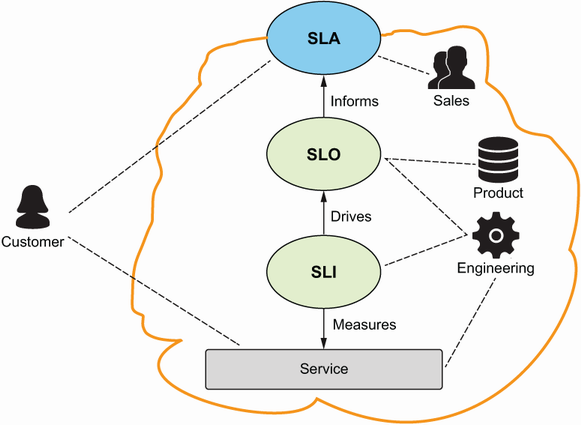
Use the dependency diagram to distinguish SLAs, SLOs, and SLIs and see how customer, business, product, and engineering roles connect. section 10.1


