A service-level objective (SLO) is a target based on a service-level indicator (SLI), defining the performance or availability a service should achieve. For example, a platform API might respond within 200 milliseconds 99.9% of the time. SLOs make reliability expectations explicit and help teams investigate when performance falls below them. section 5.4 section 10.4.1
Uptime expressed as a series of nines does not capture every user experience. A service that is usually fast but suffers two long outages may be worse for human users than one that is consistently slower. Choose measures that reflect customer needs, including latency, throughput, error rates, or availability, and publish the resulting goals. section 5.4 section 10.4.2
Implement SLOs as an observable reliability practice:
- Select an SLI that represents a meaningful user or business outcome. section 5.4.1 section 10.4.2
- Define the target from collected monitoring data and document why it matches user expectations. section 5.4.1
- Track the target, current error-budget usage, remaining monthly budget, burn rate, and warning or critical status. section 5.4.1
- Make dashboards and their supporting configuration software-defined, visible, and useful for diagnosing whether failures originate in the platform. section 5.4.1
Payment-processing reliability
A team defines SLOs and SLIs for payment processing from user needs and business priorities, then uses monitoring and alerting to detect problems before they affect customers. Error budgets help balance change velocity with system stability. section 10.4.1 section 10.4.2
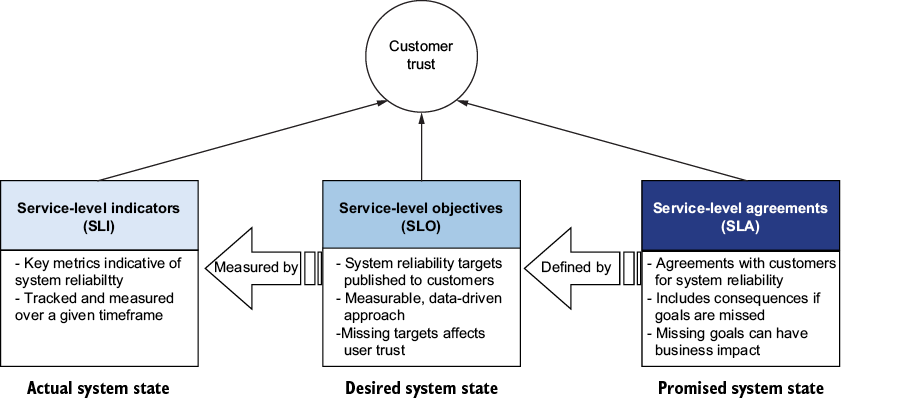
Use the relationship diagram to distinguish measured indicators, target objectives, and formal customer agreements. section 5.4


