A service registry is a database of service instances’ network locations. It supports service discovery when addresses and available instances change dynamically, as they can with autoscaling, failures, and upgrades. section 8.2.5
In application-level discovery, the registry coordinates two steps:
- Service instances register their network locations. section 8.2.5
- Clients query the registry for available instances, then send requests to one of them. section 8.2.5
Figure 8.11 The platform is responsible for service registration, discovery, and request routing. Service instances are registered with the service registry by the registrar. Each service has a network location, a DNS name/virtual IP address. A client makes a request to the service’s network location. The router queries the service registry and load balances requests across the available service instances.
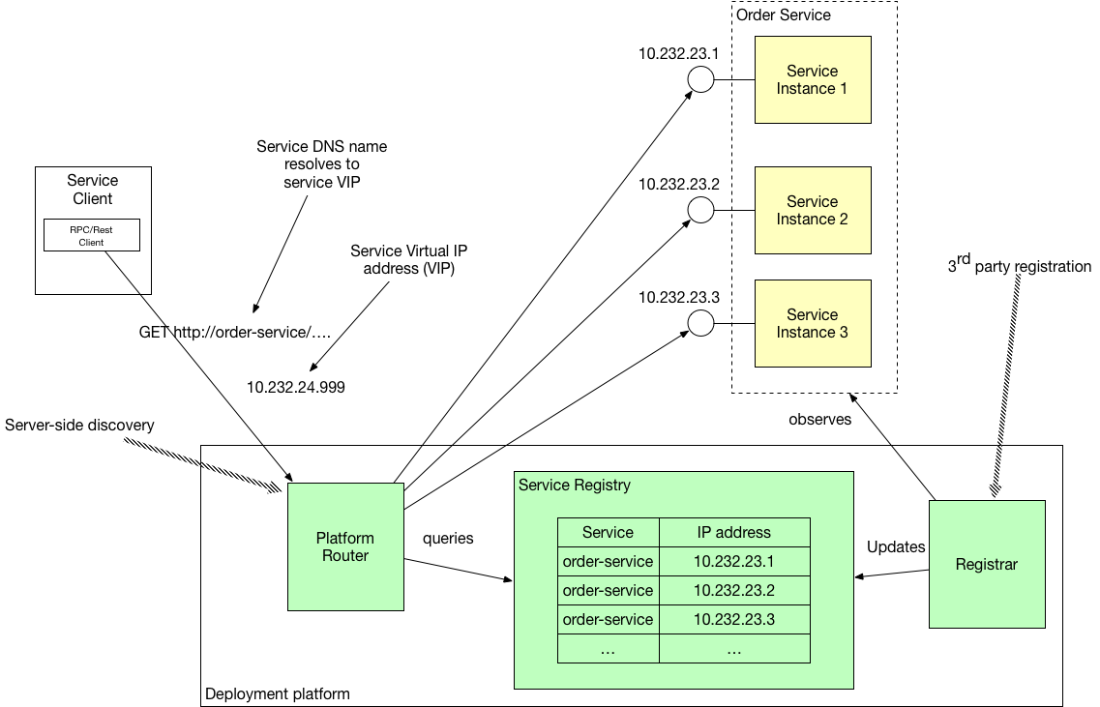
Shows platform-managed registration and discovery, with a router querying the registry and load-balancing requests across available instances. section 8.2.5
Application-level registries include Eureka, Consul, and ZooKeeper. Modern deployment platforms such as Kubernetes often provide discovery, so teams may not need to implement it in the application. section 8.2.5