SHAP (SHapley Additive exPlanations) is a model-agnostic feature-attribution technique. It estimates how much each feature contributes to a specific prediction by averaging its contribution across all possible feature combinations. This makes SHAP useful for explaining individual decisions rather than only describing overall model behavior. section 11.2.1
Use SHAP to:
- Explain why a particular prediction received its outcome by identifying the features that contributed to it. section 11.2.1
- Analyze deep-learning inputs at different levels, including pixels, tokens, characters, frequencies, and more abstract patterns. section 11.2.3
- Compare SHAP with permutation importance, LIME, and built-in measures such as linear coefficients or tree split counts. section 11.2.1 section 11.5.1
Retail feature selection
For a Supermegaretail demand model, SHAP can estimate how features such as promotion calendars, discounts, store traffic, weather, and prior sales contribute to the model’s outcome. The team uses those contributions alongside LIME, shuffle importance, and built-in measures; features contributing little may be dropped. section 11.5.1
Figure 11.3 A taxonomy of model explanation methods
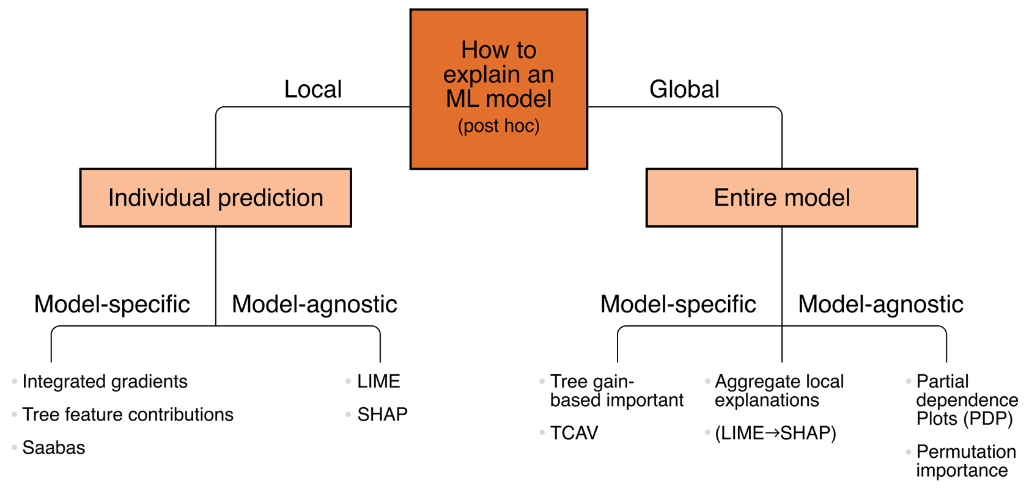
Use the taxonomy to locate SHAP among model-agnostic explanation methods and distinguish local explanations from whole-model interpretation. section 11.2.1




