Shor's algorithm is a quantum algorithm for integer factorization. Given a single number, it exploits the periodicity of a related function to find divisors, promising asymptotically better performance than the best known classical factorization algorithms. section 1.2 section 1.3.1
Its potential advantage depends on several conditions:
- Targets a small-data, big-compute problem: the input may be one number, while discovering its divisors is computationally hard. section 1.2
- Exploits structure rather than treating the problem as unstructured search; specifically, it relies on periodicity in a function defined from the number being factored. section 1.2
- Requires practical implementation analysis in addition to abstract computational complexity, because implementation details can reduce the value of a theoretical speedup. section 1.3.1
Figure 1.1 Quantum advantage might be achievable if the time a quantum computer takes to solve a certain problem grows at a slower rate as the problem size increases than the time a classical computer takes to do the same. In this case, problem instances that are much larger than the crossover size might be good candidates for quantum solutions. If the crossover time is months or more, quantum computing offers no practical advantage, since larger problem instances take much longer to solve, and running a quantum computer for months or years to solve a single problem is not practical.
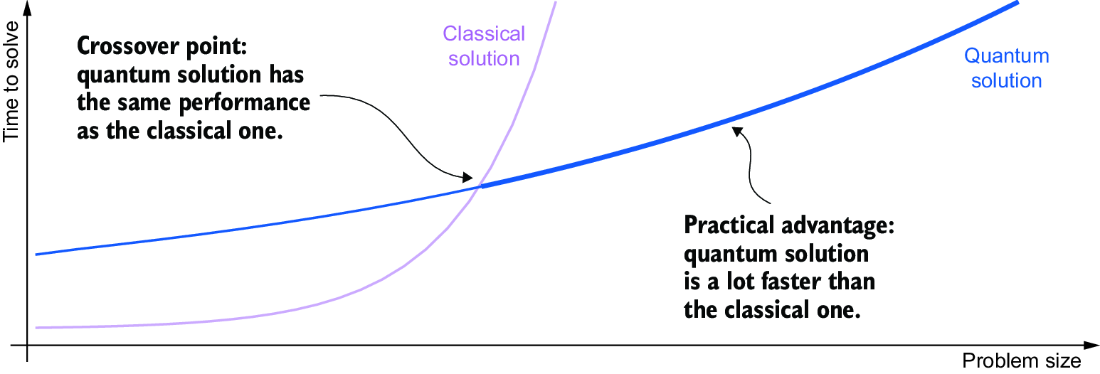
Compare quantum and classical growth rates using the crossover point: a slower quantum growth rate may matter only when instances exceed a practical crossover size. section 1.2

