Shot learning guides a language model by showing examples of the output pattern you want, rather than fine-tuning its behavior. Zero-shot prompting gives instructions without examples; one-shot gives one example; few-shot gives several. section 3.1
Choose the approach according to how much guidance the task needs:
- Zero-shot: describe the task and the expected features without an example. section 3.1
- One-shot: include one desired response, such as a sample concise summary or title. section 3.1
- Few-shot: provide multiple responses to demonstrate variation and formatting nuances. section 3.1
Prompting a title or classification pattern
A prompt might say, “A good title would be something like ‘X’,” or show that input “X” should produce output “Y” rather than “Z.” These examples make the intended answer type easier to emulate. section 3.1
Figure 3.3 The more examples you give the LLM, the easier the climb.
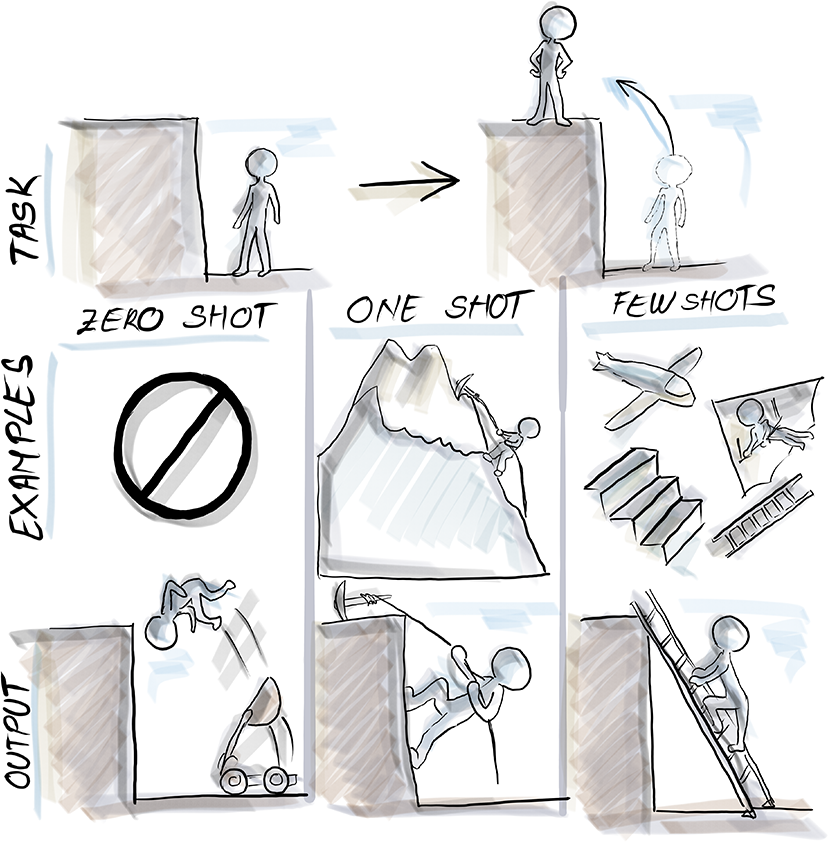
The figure reinforces how adding examples can make the desired output easier for an LLM to follow. section 3.1
