A sign conveys meaning by standing for or indicating something else. In language, signs connect observable forms with interpretation, making them useful for examining how people and language models produce meaningful output. section 2.1.2
Semiotics relates signs to signifiers and abstractions. A recursive semiotic triangle organizes meaning-making into interconnected parts and uses firstness, secondness, and thirdness as markers for the sequence of interpretation. The model clarifies the process without attempting a complete treatment of semiotic philosophy. section 2.1.2
Figure 2.2 A recursive Peircean semiotic triangle is a system of organizing the process of extracting meaning from anything—in our case, from language. Each point on the triangle illustrates one of the minimal parts needed to synthesize meaning within whatever the system is being used to describe, so each point is a minimal unit in meaning for language. Firstness, secondness, and thirdness are not points on the triangle; instead, they are more like markers for the people versed in semiotics to be able to orient themselves in this diagram.
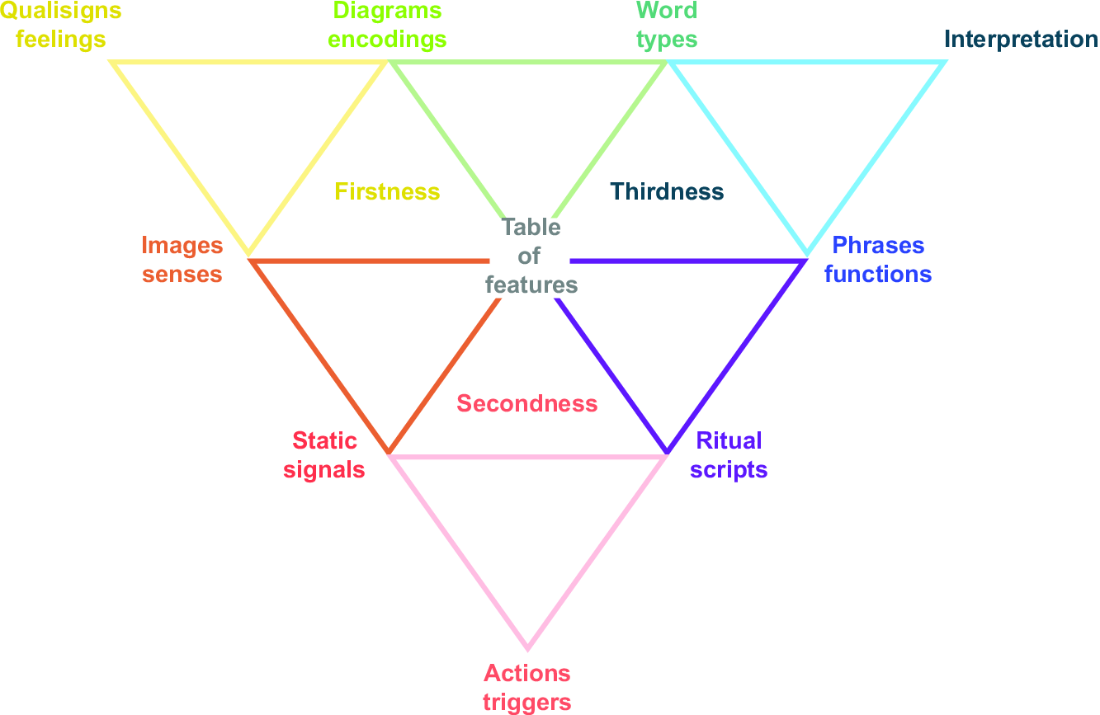
Use the recursive Peircean semiotic triangle to trace minimal meaning-making units and their relationships. section 2.1.2
