A signifier is the perceptible form or representation through which a sign conveys meaning. In language and LLMs, it provides one part of the process by which people and systems interpret words, symbols, and other forms. section 2.1.2
Treating a signifier as part of a larger semiotic process helps separate the form encountered from the meaning or abstraction interpreted. This framing clarifies both how LLMs generate meaningful output and why human-like language behavior does not necessarily establish human understanding. section 2.1.2
Figure 2.2 A recursive Peircean semiotic triangle is a system of organizing the process of extracting meaning from anything—in our case, from language. Each point on the triangle illustrates one of the minimal parts needed to synthesize meaning within whatever the system is being used to describe, so each point is a minimal unit in meaning for language. Firstness, secondness, and thirdness are not points on the triangle; instead, they are more like markers for the people versed in semiotics to be able to orient themselves in this diagram.
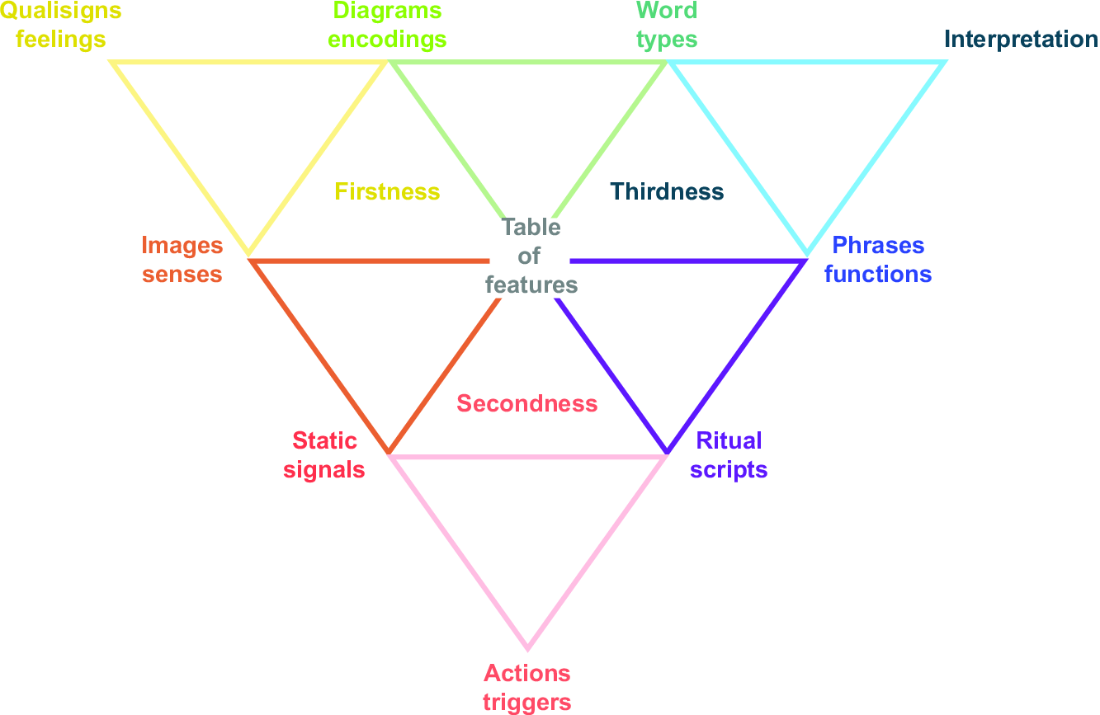
Use the recursive semiotic triangle to trace the minimal parts involved in extracting meaning from language and to distinguish signifiers from related elements. section 2.1.2
