liveBook · Manning

Signal-to-noise ratio

As explained in Quantization and Fast Inference

Signal-to-noise ratio is the ratio of the magnitude or power of a desired signal to that of an accompanying noise component.

Signal-to-noise ratio compares a desired signal’s magnitude or power with accompanying noise. In post-training quantization (PTQ), it shows how much quantization noise grows as precision falls. section 4.1

The decline is steep rather than gradual: at INT8, quantization noise is about 16,000 times smaller than the signal; at INT4, it is only about 50 times smaller. The lower ratio helps explain why INT8 PTQ often succeeds, while INT4 commonly needs group quantization to preserve resolution. section 4.1

Figure 4.1 Left: Signal-to-Noise ratio by bit-width with PTQ viability zones. Right: Signal-to-noise ratio as intuitive ratios
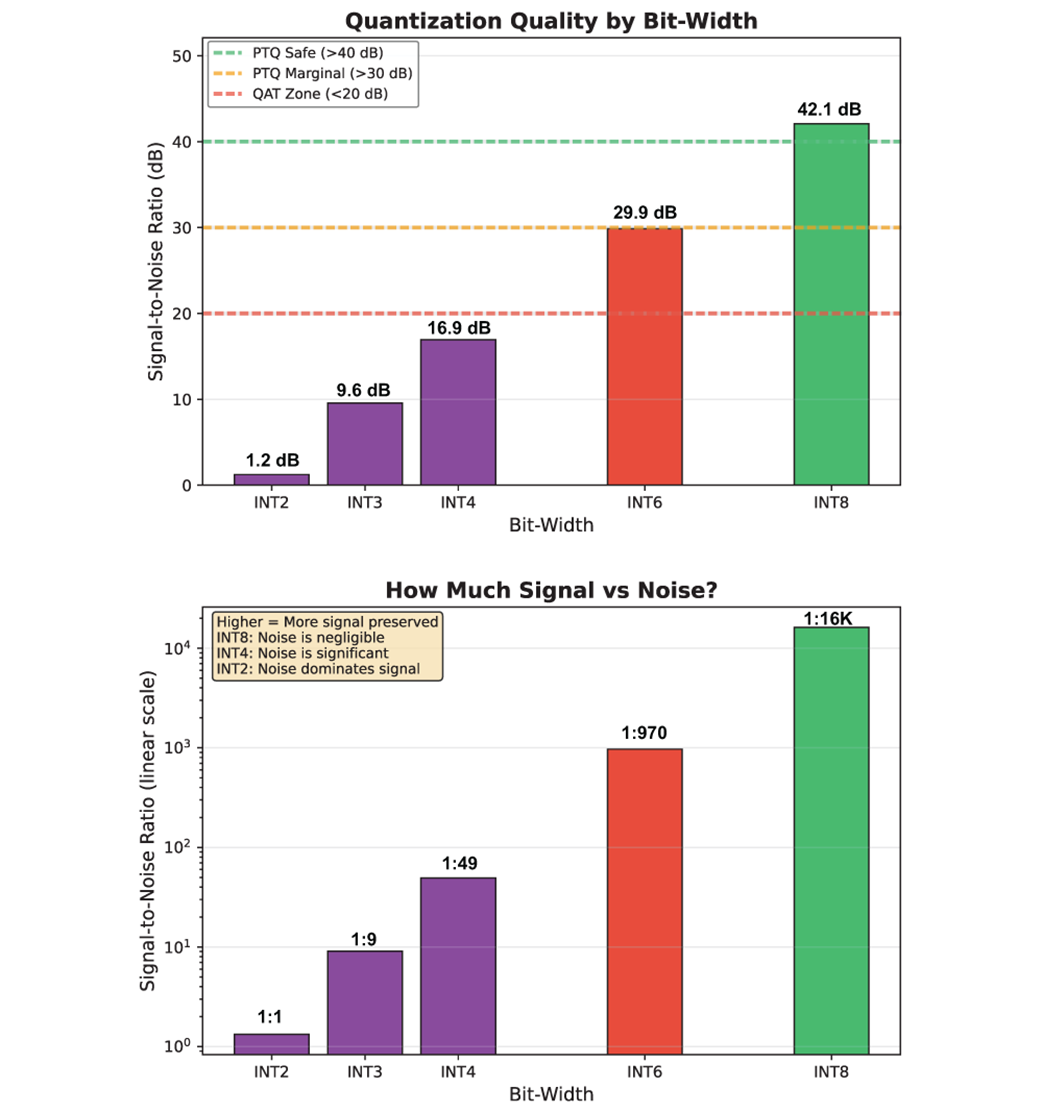
Compare signal-to-noise ratios across bit-widths and their intuitive interpretations. section 4.1


How Quantization and Fast Inference covers it

How deep it goes
Quantifies INT8 and INT4 noise relative to signal, but gives no derivation of the ratio.
Examples
Compares INT8 noise at roughly 1/16,000 of signal with INT4 noise at roughly 1/50.
What you can do after
Evaluate how reduced precision changes quantization noise and PTQ viability.
How it connects
Links quantization noise with post-training quantization and group quantization.

Also explained in

Compare how 2 books explain signal-to-noise ratio →

Related concepts

This explainer was generated by Manning's knowledge graph from the text of Quantization and Fast Inference. The section links point to the parts of the book it draws on.