liveBook · Manning

Single-mode fiber

As explained in Acing the CCNA Exam: Volume 1 Fundamentals and Protocols

Single-mode fiber is optical fiber designed to carry a single propagation mode over relatively long distances with low dispersion.

Single-mode fiber (SMF) is a fiber-optic cable with a very narrow glass core that carries light at a single angle. It supports much longer distances than multimode fiber, making it useful for network infrastructure connections. section 3.4.1 section 3.5

Key points for comparing SMF with other cabling:

  • Uses laser transmitters, which are typically more expensive than the LED transmitters used with multimode fiber. section 3.4.1
  • Supports distances up to tens of kilometers, compared with several hundred meters for multimode fiber. section 3.4.1
  • Often connects infrastructure devices across floors or buildings, while copper UTP commonly connects end hosts to switches. section 3.5
  • Uses small form factor pluggable (SFP) transceivers, contributing to higher connection costs than copper UTP. section 3.5
Figure 3.10 Light travels down an MMF cable at multiple angles (modes), whereas light travels down SMF cables at a single angle.
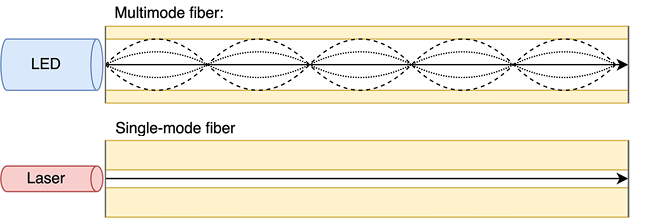
Compare the single-angle light path in SMF with the multiple-angle paths in multimode fiber. section 3.4.1

How Acing the CCNA Exam: Volume 1 Fundamentals and Protocols covers it

How deep it goes
Explains core width, light propagation, transmitters, distance, and cost, but does not detail optical engineering.
Examples
Uses light-path diagrams, SFP-equipped switches, and infrastructure links between floors or buildings.
What you can do after
Evaluate fiber choices by propagation mode, supported distance, transmitter type, deployment role, and cost.
How it connects
Connects single-mode fiber with multimode fiber, fiber-optic cabling, laser transmitters, SFP transceivers, and copper UTP.

Related concepts

This explainer was generated by Manning's knowledge graph from the text of Acing the CCNA Exam: Volume 1 Fundamentals and Protocols. The section links point to the parts of the book it draws on.