liveBook · Manning

Single-stage detector

As explained in Deep Learning with Python, Third Edition

An object-detection architecture that predicts bounding boxes and class labels in one pass with a single model, rather than using separate proposal and classification stages.

A single-stage detector finds objects and their locations in one pass: one model jointly predicts bounding boxes, labels, and confidence scores instead of first proposing regions and then classifying them. This design favors speed and efficiency, making it useful for real-time or resource-constrained applications. section 12.1.2 section 12.1.1

Figure 12.1 Object detectors draw boxes around objects in an image and label them.
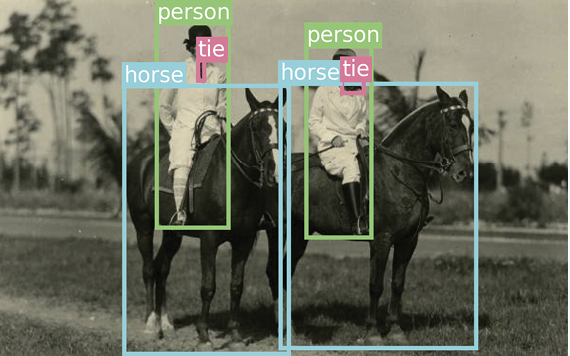
object detection

Bounding boxes show the detector’s practical output: each detected object receives a location and a label. section 12.0

A simplified YOLO detector

YOLO divides a 448 × 448 image into a grid and predicts one bounding box, confidence score, and class label at each grid location. A ConvNet backbone extracts features; a prediction head reshapes them into grid outputs, separating five box-related values from class probabilities. Empty grid locations should produce near-zero confidence. section 12.2.2

Use the architecture when:

  • You need fast detection for real-time applications such as self-driving systems. section 12.4
  • Bounding boxes are sufficient, because segmentation would add pixel-level labeling and computational costs. section 12.0
  • You accept a possible minor accuracy tradeoff for greater speed and efficiency than two-stage detectors. section 12.1.2
How Deep Learning with Python, Third Edition covers it

How deep it goes
Explains joint outputs, grid prediction, confidence, and backbones through a simplified YOLO build, without developing the full original architecture.
Examples
Uses counting, tracking, and cropping applications plus a grid-based YOLO model with ResNet and KerasHub.
What it assumes
Assumes familiarity with ConvNet backbones while introducing object detection through bounding boxes, labels, grids, and confidence.
What you can do after
Build a simplified YOLO detector from scratch using a pretrained ConvNet backbone and separate box and class outputs.
How it connects
Connects object detection with bounding boxes, ConvNets, YOLO, RetinaNet, SSD, R-CNN, image segmentation, and feature pyramid networks.

Also explained in

Compare how 2 books explain single-stage detector →

Related concepts

This explainer was generated by Manning's knowledge graph from the text of Deep Learning with Python, Third Edition. The section links point to the parts of the book it draws on.