A single-stage detector predicts object locations and categories together in one model pass. Unlike an R-CNN detector, it does not first generate region proposals and then classify thousands of patches. This integrated design is generally faster and more computationally efficient, making it useful for real-time and resource-constrained applications. section 12.1.1 section 12.1.2
A typical single-stage detector works by:
- Extracting high-level image features with a convolutional backbone. section 12.2.2
- Predicting bounding boxes, confidence scores, and class labels directly from those features. section 12.2.2 section 12.4
- Using a grid or multiple feature scales to associate predictions with different image locations and object sizes. section 12.2.2 section 12.3
A simplified YOLO-style detector
Resize images to 448 × 448, pass them through a pretrained ResNet backbone, and reshape the prediction head into a 6 × 6 grid. Each grid cell outputs one box plus 91 class values; the box output contains coordinates and confidence, while the class output uses softmax probabilities. The simplified model predicts one box per cell, whereas the original YOLO design predicted multiple boxes. section 12.2.2
RetinaNet follows the same single-stage principle but improves detection across object sizes with a Feature Pyramid Network. The FPN combines semantically rich deep features with higher-resolution features from earlier layers, helping detect both small and large objects. section 12.3
Figure 12.8 An FPN creates semantically interesting feature maps at different scales.
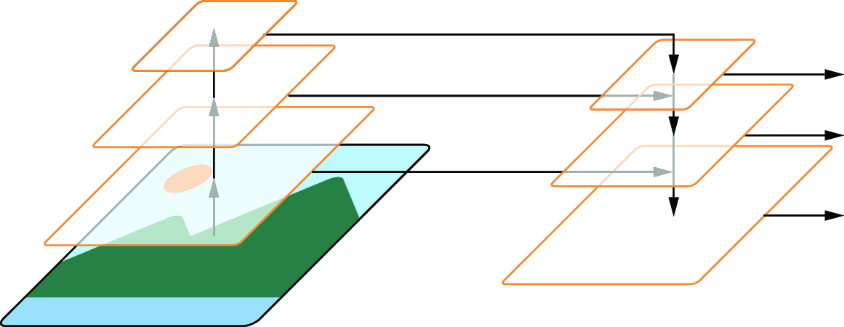
Shows how an FPN creates semantically meaningful feature maps at multiple spatial scales. section 12.3

