Skaffold automates the Kubernetes application workflow from source changes to a running deployment. A single command can build the container image, load it into the cluster, apply Kubernetes manifests, and keep development synchronized while you focus on application code. section 3.3.4 section 3.3.5
Skaffold's development workflow includes:
- Monitoring application source and configured dependencies for changes. section 3.3.5
- Rebuilding and redeploying the container, or synchronizing changed files inside the existing container, according to the technology stack. section 3.3.4
- Integrating with image builders such as Dockerfiles, Buildpacks, and ko, and deployment tools such as Helm, Kustomize, Kpt, and Kubernetes manifests. section 3.3.5
- Supporting inner-loop development as well as CI/CD pipelines and production deployments. section 3.3.5
Appointments service
A Java Appointments service stores its workflow in skaffold.yml: the configuration defines the image build command, monitored paths, manual synchronization destinations, and Kubernetes deployment behavior. Running `skaffold dev --port-forward` starts the development loop; the configuration can rebuild the application image or synchronize compiled classes and resources into the running container. section 3.3.5
Figure 3.13 Application Live-Sync (Cluster), a pattern for going continuously and automatically from application source code to containerized application deployed on Kubernetes in one single operation.
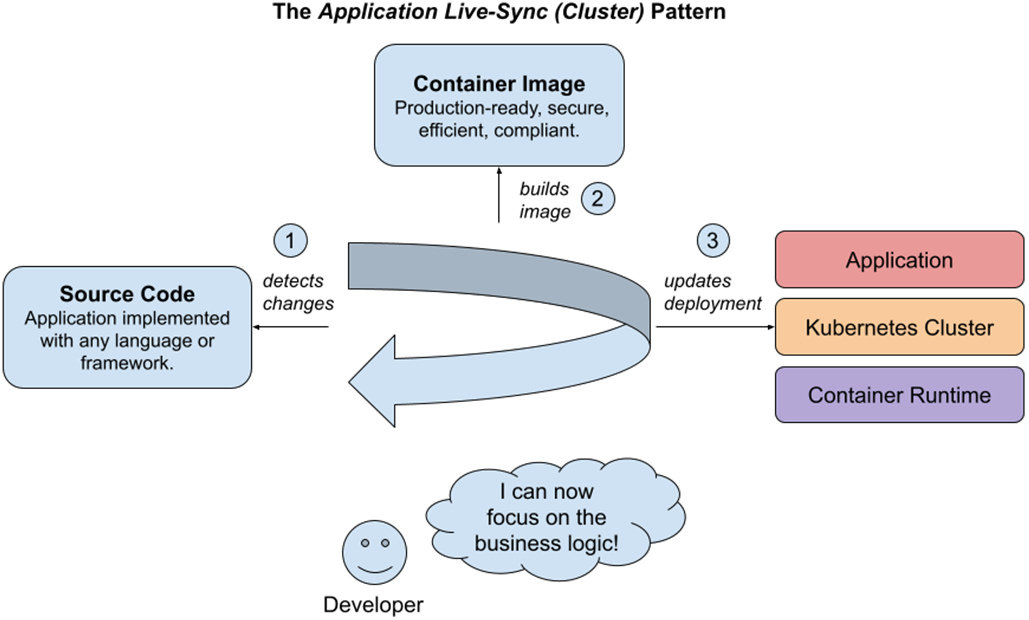
The live-sync pattern diagram shows the continuous path from application source code to a containerized application deployed on Kubernetes. section 3.3.4