liveBook · Manning

Image denoising

As explained in Machine Learning Algorithms in Depth

Image denoising is the computational restoration of an image by reducing noise while preserving meaningful visual structure.

Image denoising recovers a binary latent image from noisy pixel observations by combining Gaussian observation noise with an Ising-model smoothness preference: neighboring pixels favor the same state. section 3.3

A mean-field variational treatment proceeds by:

  • Representing pixels as latent variables xi ∈ {−1,+1} on a two-dimensional grid, with observations yi modeled using Gaussian noise. section 3.3
  • Encoding spatial smoothness through positive coupling J and interaction potentials that reward matching neighboring states. section 3.3
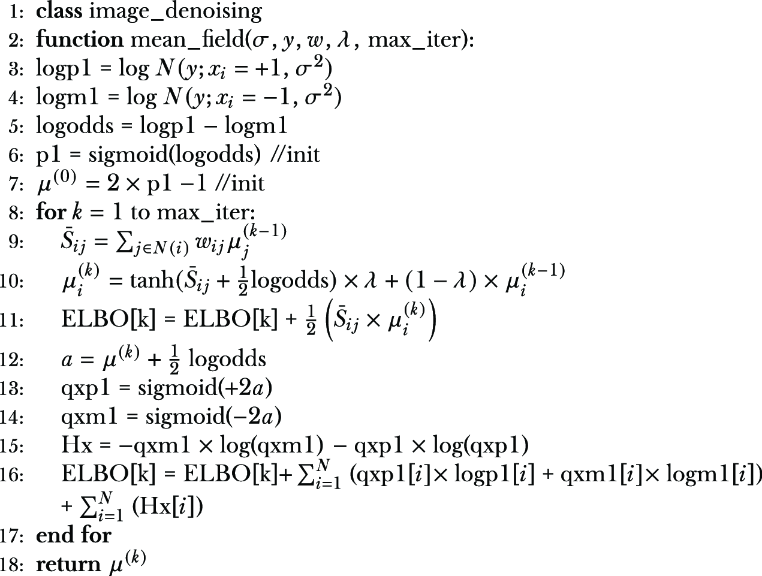
  • Approximating the posterior with a fully factored q(x), maximizing the ELBO, and updating each qi from neighboring means μj. section 3.3
Figure 3.5 Mean field VI for Ising model pseudo-code
figure

Pseudo-code summarizes the iterative mean-field variational inference procedure for the Ising denoising model. section 3.3

How Machine Learning Algorithms in Depth covers it

How deep it goes
Derives mean-field updates from the ELBO and KL objective, then provides pseudo-code; it stops short of a complete implementation listing.
Examples
Uses a noisy two-dimensional binary-pixel grid, Ising interaction potentials, and mean-field update pseudo-code.
What you can do after
Build it from scratch by implementing mean-field variational inference for an Ising-based denoising model.
How it connects
Connects image denoising with Markov random fields, Ising models, mean-field approximation, ELBO, and KL divergence.

Related concepts

This explainer was generated by Manning's knowledge graph from the text of Machine Learning Algorithms in Depth. The section links point to the parts of the book it draws on.