An SNMP GetBulk request lets a network management system retrieve many management-information values or a range of OIDs in one operation. It can walk the management information tree more efficiently than GetNext, which returns one successive OID at a time. section 6.2.1
Key operational facts:
- GetBulk belongs to SNMP's Read message class and retrieves information from managed devices. section 6.2.1
- The NMS can specify an OID range instead of identifying every individual OID. section 6.2.1
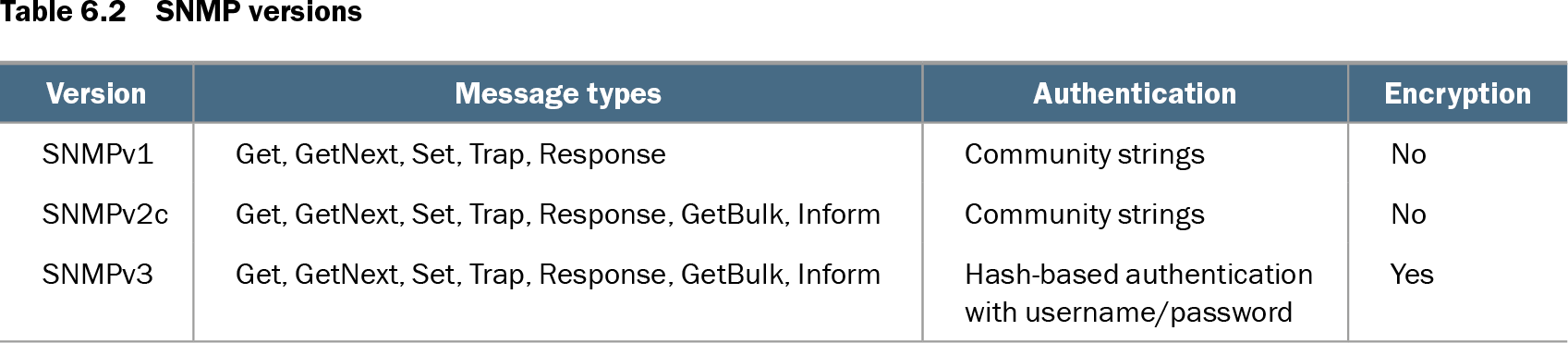
- SNMPv1 does not support GetBulk; SNMPv2c and SNMPv3 do. section 6.4 section 6.3
- A read-only community string permits Get, GetNext, and GetBulk requests but not Set operations. section 6.3.1
Walking a sequence of OIDs
Given consecutive OIDs such as 1.3.6.1.2.1.1.1, 1.3.6.1.2.1.1.2, and 1.3.6.1.2.1.1.3, GetNext discovers them one at a time; GetBulk requests multiple successive values more efficiently. section 6.2.1
Table 6.2 SNMP versions (view table figure)
| Version |
Message types |
Authentication |
Encryption |
|---|---|---|---|
| SNMPv1 |
Get, GetNext, Set, Trap, Response |
Community strings |
No |
| SNMPv2c |
Get, GetNext, Set, Trap, Response, GetBulk, Inform |
Community strings |
No |
| SNMPv3 |
Get, GetNext, Set, Trap, Response, GetBulk, Inform |
Hash-based authentication with username/password |
Yes |
Compare message types, authentication, and encryption across SNMPv1, SNMPv2c, and SNMPv3. section 6.3