SNMP GetNext retrieves the next object identifier (OID) in a management-information tree and returns its value. An NMS uses it to discover available information without knowing every OID beforehand, an operation commonly called walking the tree. section 6.2.1
Use GetNext to:
- Request one successive OID at a time. section 6.2.1
- Retrieve the next OID and its associated value. section 6.4
- Distinguish it from GetBulk, which retrieves many OIDs or a range more efficiently. section 6.2.1
- Send requests with a read-only community, which permits Get, GetNext, and GetBulk but not Set. section 6.3.1
Walking adjacent OIDs
Given OIDs 1.3.6.1.2.1.1.1, 1.3.6.1.2.1.1.2, and 1.3.6.1.2.1.1.3, a GetNext request for 1.3.6.1.2.1.1.1 returns 1.3.6.1.2.1.1.2 and its value. section 6.2.1
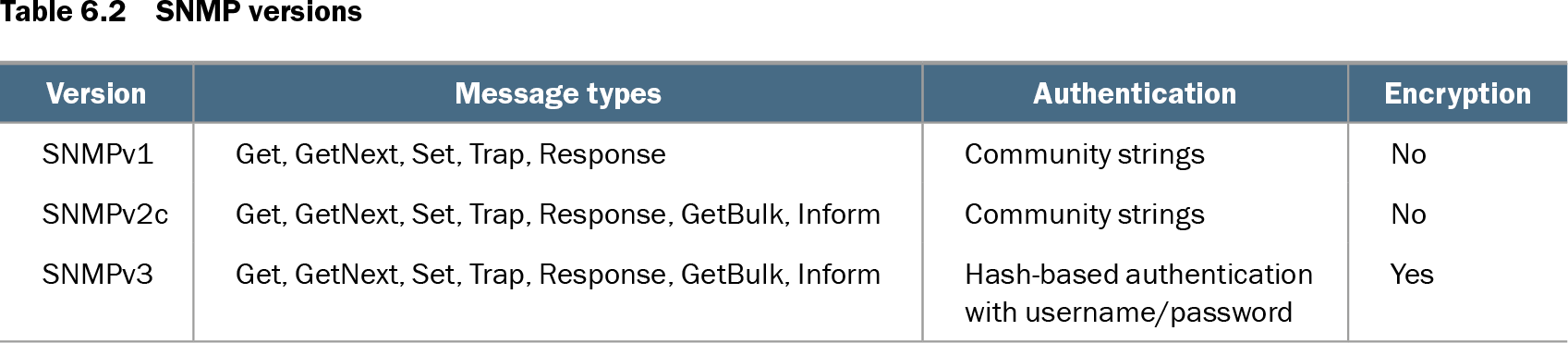
Table 6.2 SNMP versions (view table figure)
| Version |
Message types |
Authentication |
Encryption |
|---|---|---|---|
| SNMPv1 |
Get, GetNext, Set, Trap, Response |
Community strings |
No |
| SNMPv2c |
Get, GetNext, Set, Trap, Response, GetBulk, Inform |
Community strings |
No |
| SNMPv3 |
Get, GetNext, Set, Trap, Response, GetBulk, Inform |
Hash-based authentication with username/password |
Yes |
Compare GetNext availability and authentication across SNMPv1, SNMPv2c, and SNMPv3. section 6.3