SNMPv2 is the second major SNMP version, adding GetBulk and Inform messages. Inform notifications require acknowledgment and are retransmitted if lost, making them more reliable than Traps. section 6.4 section 6.3
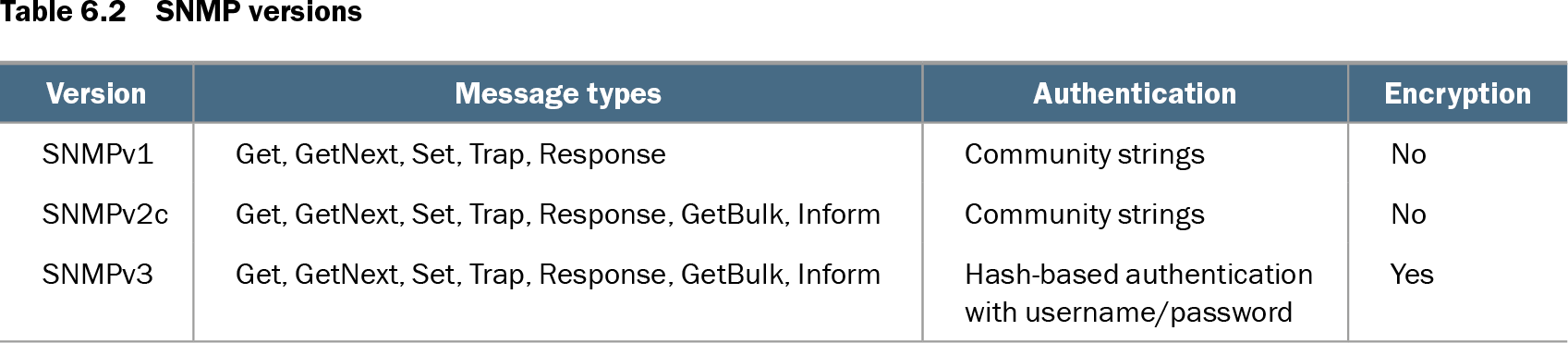
Distinguish the widely implemented versions by message support and security:
- SNMPv1 supports Get, GetNext, Set, Trap, and Response, using community strings without encryption. section 6.3
- SNMPv2c adds GetBulk and Inform while retaining community-string authentication; read-only and read-write strings control permitted operations. section 6.4 section 6.3
- SNMPv3 retains the expanded message set and adds username/password hash-based authentication, message integrity, and encryption. section 6.4 section 6.3
Cisco IOS configuration
Configure community access with `snmp-server community community-string {RO | RW} [acl]`. Enable Trap messages with `snmp-server enable traps`, then identify a notification receiver with `snmp-server host ip-address [version 2c] community-string`. section 6.4
Table 6.2 SNMP versions (view table figure)
| Version |
Message types |
Authentication |
Encryption |
|---|---|---|---|
| SNMPv1 |
Get, GetNext, Set, Trap, Response |
Community strings |
No |
| SNMPv2c |
Get, GetNext, Set, Trap, Response, GetBulk, Inform |
Community strings |
No |
| SNMPv3 |
Get, GetNext, Set, Trap, Response, GetBulk, Inform |
Hash-based authentication with username/password |
Yes |
Compare SNMP versions by message types, authentication, and encryption. section 6.3