Scrolling past friends’ accomplishments can prompt a familiar question: How am I doing compared with them? Social comparison is the process of evaluating ourselves and our opinions against those of other people. Rather than forming self-evaluations in isolation, we use others as a reference point. section 8.1.1 section 7.1
Social comparison is connected to group belonging. People may shape their views in response to peers, while social identity theory considers how identifying with a group affects attitudes toward its members and their actions. On social media, the groups used for comparison can be arbitrarily defined. section 8.1.1
Figure 8.1 An example of how the shape of the network, i.e., its connections, influences the flow of information. In diagram A, the circle nodes are better connected than the square ones. Because of that, the square nodes would receive more information from the circular ones, giving the impression that their opinion is the majority. In contrast, a different network shape, shown on the right, can lead to a very different spread of information where the square nodes receive the majority of their information from other square nodes.
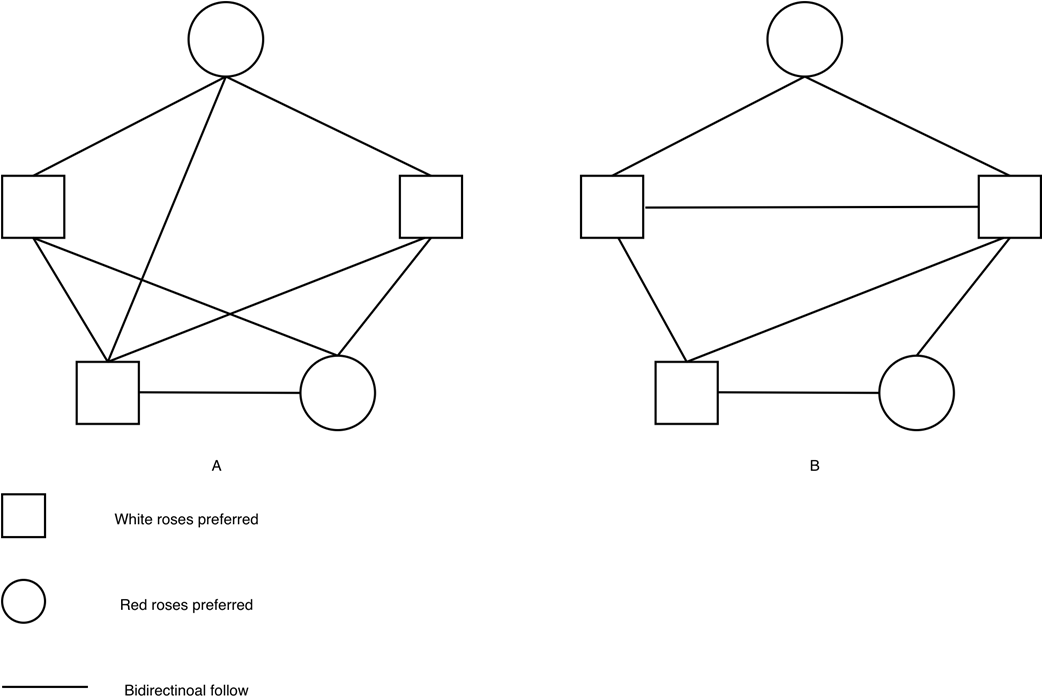
The network diagram shows how connections affect which opinions people encounter—and can make an opinion seem more common than it is. section 8.1.1
Comparing success on social media
Posts about accomplishments raise the concern that constant comparison with apparently more successful friends could make people sadder. Researchers interpreting a social contagion study reported the opposite: exposure to friends’ success was associated with a more positive outcome. That finding is a study takeaway, not proof that every comparison has the same effect. section 7.1
Social comparison helps explain why the people and opinions encountered online matter. Its effects depend on the social setting and what people are exposed to, rather than on technology alone. section 8.1.1 section 7.1
