Soft clustering groups similar objects while preserving uncertainty: an object receives a likelihood or membership score for each cluster and may belong to several clusters. This contrasts with hard clustering, which assigns each object to one cluster. section 2.2 section 5.5
Soft clustering is useful when cluster boundaries overlap:
- Points near a cluster center have stronger membership than points near its edge. section 5.5
- Fuzzy clustering uses membership degrees and can locate an item in the probability space between clusters. section 5.5
- Fuzzy C-means controls fuzziness with the hyperparameter m, while Gaussian mixture models use distributions and covariance for soft assignments. section 5.9
Overlapping observations
Consider points near the boundary between two groups. Instead of assigning each point exclusively to one group, soft clustering gives it scores for both, making overlap explicit. Fuzzy clustering expresses this through membership; a Gaussian mixture model expresses it through probabilities. section 5.5 section 5.9
Figure 5.15 The figure on the left represents all the data points. The red points (those with an x in the print version) can belong to more than one cluster. In fact, we can allocate more than one cluster to each point. A probability score can be given for a point to belong to a particular cluster.
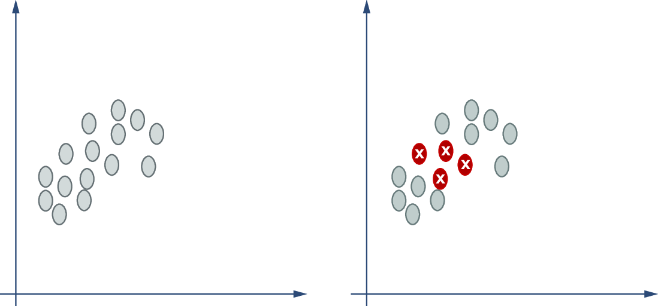
Use the figure to inspect how boundary points can receive assignments to multiple clusters and probability scores for each. section 5.5

