A source of truth is the authoritative system or record used to determine canonical information. In architecture, it may hold business state, infrastructure configuration, or event schemas. section 1.7.2 section 10.2.2
Common architectural choices include:
- An indefinitely retained Kafka log can be authoritative for entity state: consumers replay immutable changes and reconstruct the current value locally. section 1.7.2
- Git can be authoritative for Kafka infrastructure: declarative YAML or JSON defines the desired cluster state, while CI/CD reconciles differences. section 10.2.2
- An Avro schema stored in Git can be authoritative for event structure, with AsyncAPI referencing the concrete schema. section 6.3.5
Customer address reconstruction
CustomerService publishes address updates to a retained change-log topic. A service that needs customer addresses replays the log from the beginning and stores the resulting state in memory or a local database. The log remains authoritative, while the local copy supports application use and enrichment of order streams. section 1.7.2
Figure 10.1 Applying Kafka cluster modifications via GitOps: after the updated Kafka cluster configuration is pushed, the CI/CD pipeline retrieves the current cluster state, calculates the required modifications, and applies them.
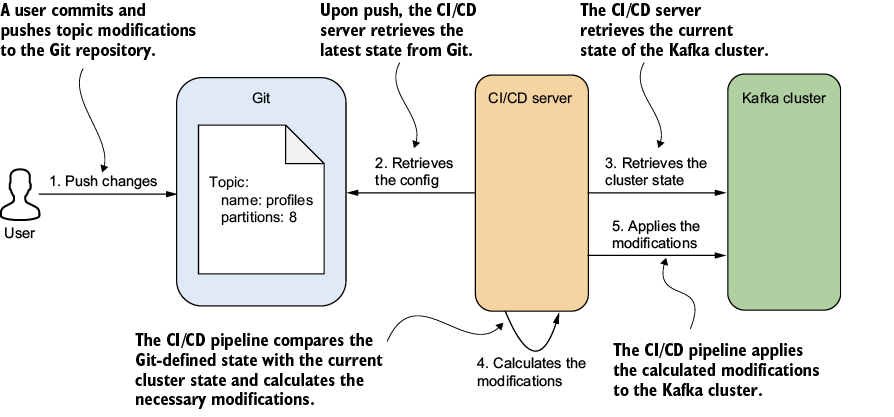
The diagram shows GitOps reconciliation: a pipeline compares the Kafka cluster with the desired configuration in Git and applies only the required modifications. section 10.2.2







