A spatial hierarchy organizes visual understanding from small local patterns to increasingly complex patterns across convolutional layers: edges can combine into parts, which can combine into objects. section 8.1.1
Convolutional networks build this hierarchy through:
- Early layers detect small local patterns such as edges or textures. section 8.1.1
- Later layers combine earlier features into larger and more abstract visual concepts. section 8.1.1
- Downsampling makes successive layers view larger portions of the original image while concentrating information increasingly in channels. section 8.1.2
Why pooling matters for digit recognition
A 28 × 28 digit model with three 3 × 3 convolutions but no pooling ends with 22 × 22 feature maps. Its later filters see only 7 × 7 regions of the input, limiting access to the whole digit. Max-pooling with 2 × 2 windows and stride 2 reduces feature-map size and expands the effective visual context. section 8.1.2
Figure 8.2 The visual world forms a spatial hierarchy of visual modules: elementary lines or textures combine into simple objects such as eyes or ears, which combine into high-level concepts such as “cat.”
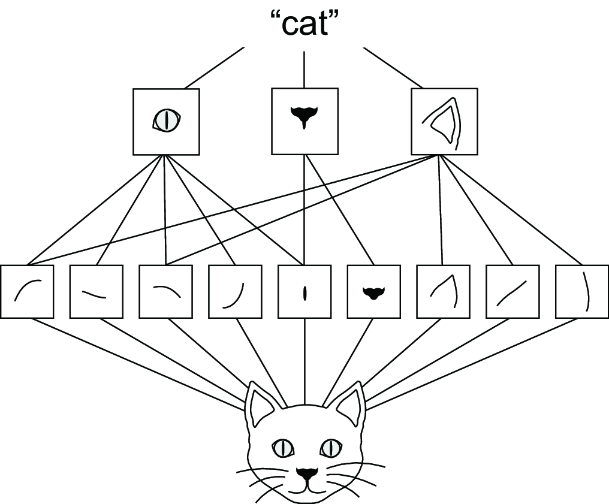
Visualize how elementary lines and textures combine into parts and then high-level object concepts. section 8.1.1

