A spatial hierarchy organizes visual understanding from small, local patterns to larger and more abstract structures. In a ConvNet, early convolution layers detect features such as edges; later layers combine them into textures, parts, and whole objects. Because the same local patterns can appear anywhere, this layered organization supports translation-invariant recognition. section 8.1.1
From edges to cats
Imagine recognizing a cat. Small patterns such as lines and textures combine into parts such as eyes or ears, which combine into the high-level concept of a cat. Downsampling helps successive layers see increasingly large portions of the original image instead of keeping high-level features confined to tiny windows. section 8.1.1 section 8.1.2
Use these rules when structuring a convolutional model:
- Stack convolution layers to build increasingly complex patterns from earlier feature maps. section 8.1.1
- Downsample with max pooling, convolution strides, or average pooling so information becomes less spatially distributed and more concentrated in channels. section 8.1.2
- Avoid removing downsampling when the task requires high-level features to cover the whole input. section 8.1.2
Figure 8.2 The visual world forms a spatial hierarchy of visual modules: elementary lines or textures combine into simple objects such as eyes or ears, which combine into high-level concepts such as “cat.”
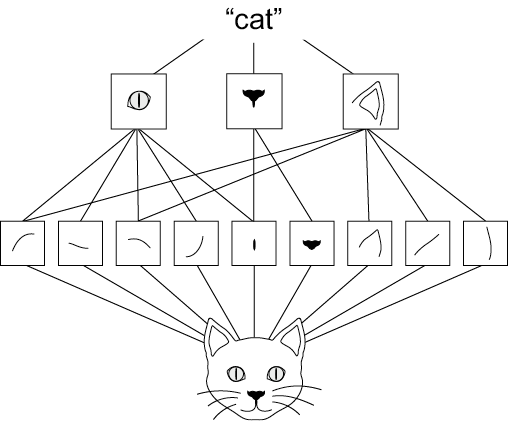
Visualize how elementary lines and textures combine into object parts and high-level concepts. section 8.1.1

