A specialist model starts with a general-purpose foundation and receives additional training for a particular domain. That training adapts its vocabulary, conventions, and reasoning patterns without replacing the underlying next-token prediction mechanism. section 2.2.4
One foundation, different domains
A coding specialist learns from source code, technical documentation, bug reports, and programming discussions. Legal and medical specialists instead receive contracts, regulations, judicial documents, clinical literature, or healthcare datasets. Each remains a next-token predictor, but its learned domain fluency changes what it can produce. section 2.2.4
Specialization can also extend beyond text to images, audio, video, and documents. Tokens, embeddings, attention, and prediction remain central; only the input types and additional training broaden. section 2.2.4 section 2.3
Figure 2.9 The four stages that turn a prediction engine into a specialist. Pretraining builds a foundation model from trillions of tokens; fine-tuning teaches it to follow instructions; alignment shapes its behavior through human feedback. Specialization is the final step: the same foundation, redirected toward a specific domain. The core mechanism never changes: predict the next token, one step at a time.
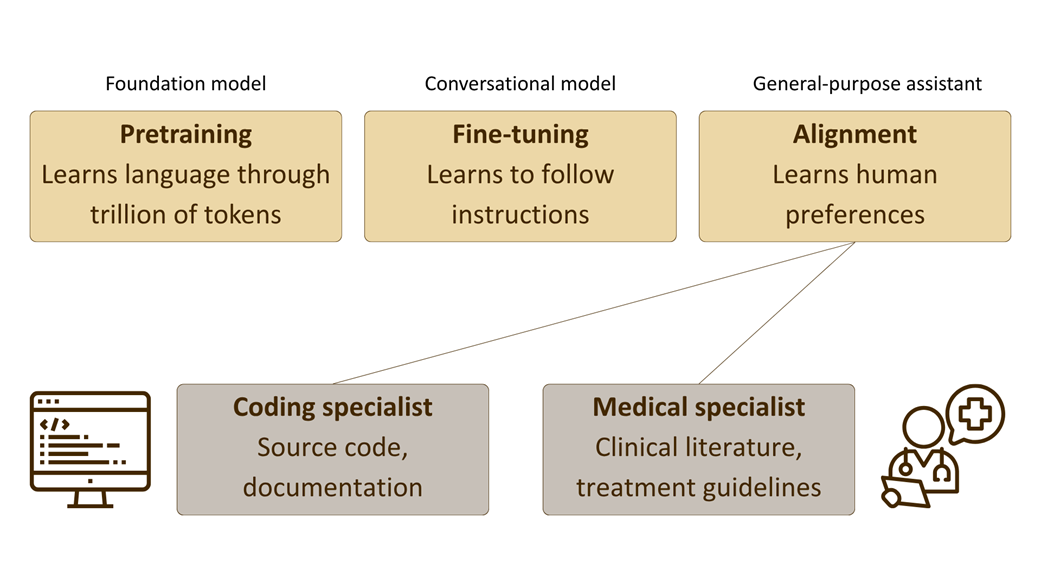
Use the staged diagram to distinguish pretraining, instruction fine-tuning, alignment, and final domain specialization. section 2.2.4



