A split asks a feature-based question and divides the examples at a decision-tree node into two subsets. The goal is to make the resulting groups easier to classify. section 9.4 section 9.9
A practical split follows this pattern:
- Choose candidate questions, such as “Is the user younger than 20?” section 9.9
- Divide the data into the examples answering yes and those answering no. section 9.9
- Compare weighted accuracy, Gini impurity, and entropy, then select the strongest split. section 9.9
- Stop splitting a pure group and turn it into a leaf node; continue with groups that still contain mixed labels. section 9.4
A small age split
For ages 12, 14, 15, 25, 32, and 35, possible cutoffs lie between consecutive ages. The question “Is the user younger than 20?” creates labels {A, A, A} and {C, B, C}, reaches 5/6 accuracy, and has the lowest listed Gini impurity and entropy. section 9.9
Figure 9.19 A graphic of the seven possible ways to split the users by age. Note that it doesn’t matter where we put the cutoffs, as long as they lie between consecutive ages (except for the first and last cutoff).
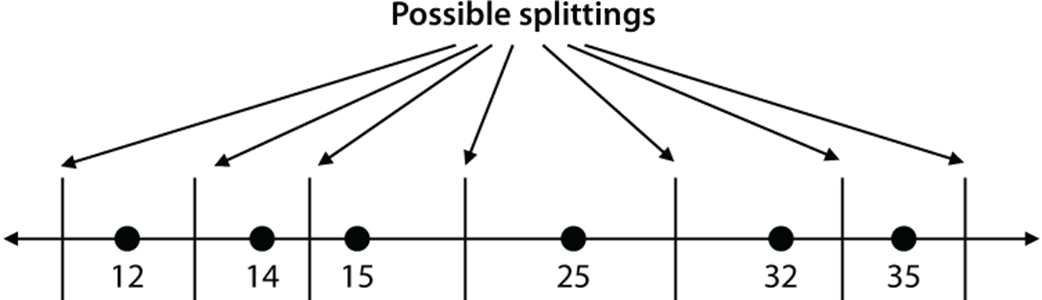
Visualizes the possible age cutoffs and shows why thresholds between consecutive ages produce distinct partitions. section 9.9



