Before comparing prices or treatments, ask whether each treatment has one clear meaning and whether one unit’s treatment can change another unit’s outcome. SUTVA requires well-defined treatment versions and no interference between units. section 10.1.4
Check SUTVA through two practical questions:
- Are treatment versions interchangeable? Surgery performed by different doctors or using different techniques may represent different interventions. section 10.1.4 section 10.2.2
- Can one unit’s treatment affect another unit’s outcome? If so, outcomes depend on other units’ treatment assignments, creating interference. section 10.1.4
Competing bike prices
Randomly changing the prices of competing bike models A and B does not isolate each price’s effect if lowering A’s price reduces purchases of B. The units interfere, so ordinary potential-outcome comparisons violate SUTVA and require specialized methods. section 10.1.4 section 10.2.2
Figure 10.2 Price effect on competing products. There is interference between prices, so we cannot assume SUTVA.
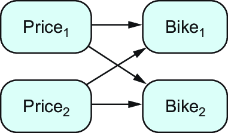
Use the figure to visualize how prices of competing products interfere with one another. section 10.2.2
DAGs handle treatment versions more explicitly, and graphical approaches do not automatically assume SUTVA; interference instead affects how interventions represented by the do operator are interpreted. section 10.2.2
