liveBook · Manning

Standalone mode

As explained in Kafka Streams in Action, Second Edition

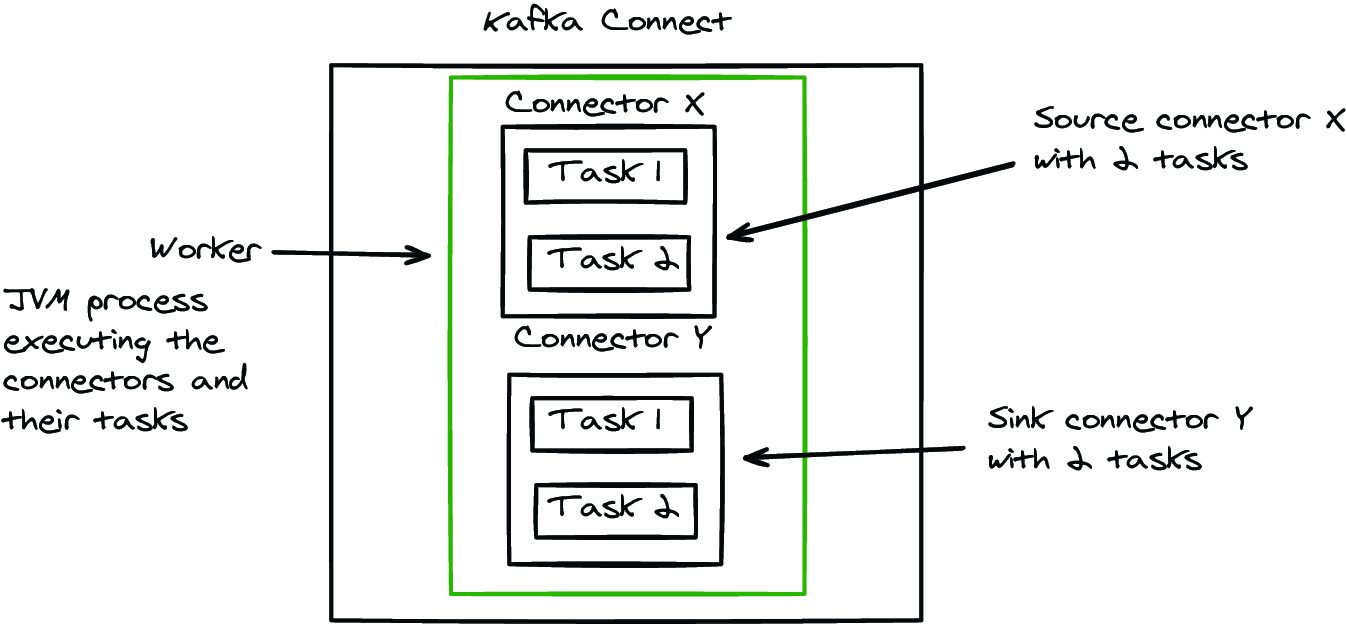
Standalone mode is a Kafka Connect operating mode in which a single worker runs connectors and their tasks.

Standalone mode runs Kafka Connect with all connectors and their tasks on one worker. It fits local development, such as experimenting on a laptop, while distributed mode suits production environments that need parallelism and fault tolerance. section 5.3

A Connect setup separates worker configuration from individual connector configuration. The worker provides defaults such as key and value converters, plugin locations, and source-connector group settings; each connector can override relevant values. section 5.3

Local JDBC source

A local standalone worker can run a JDBC source connector with tasks.max set to 1, reading PostgreSQL rows and writing them to topics with JSON values. The connector is started through the Connect REST API. section 5.3

Figure 5.3 Connect in standalone mode; all tasks reside in one worker.
figure

Use the figure to visualize every task residing in one Connect worker. section 5.3

How Kafka Streams in Action, Second Edition covers it

How deep it goes
Defines the single-worker topology and configuration layers, but defers production-scale parallelism and fault tolerance to distributed mode.
Examples
Uses a Docker-based Connect setup and a REST-started JDBC source connector with PostgreSQL, JSON values, and one task.
What it assumes
Assumes basic Kafka Connect context while introducing workers, connector configuration, converters, and plugin paths.
What you can do after
Operate/configure a local Connect worker and start a connector through the Connect REST API.
How it connects
Connects workers, connectors, tasks, converters, plugins, topics, and distributed mode.

Related concepts

This explainer was generated by Manning's knowledge graph from the text of Kafka Streams in Action, Second Edition. The section links point to the parts of the book it draws on.