Starvation occurs when one execution cannot access a shared resource because other executions keep it unavailable for a long time or indefinitely. In a read-preferring readers–writer lock, continuously arriving readers can prevent a waiting writer from ever acquiring the write lock. section 5.1.4
Readers block the writer indefinitely
Two reader goroutines repeatedly acquire a read lock, sleep for one second while holding it, print “Read done,” and release the lock. The main goroutine later requests the write lock, but the readers repeatedly overlap or alternate, so “Write finished” never appears and the output continues indefinitely. section 5.1.4
A practical remedy is a write-preferring readers–writer mutex. When a writer begins waiting, new readers wait too. The lock tracks active readers, waiting writers, and whether a writer is active; condition-variable broadcasts wake suspended executions when access may proceed. section 5.1.4 section 5.4
The write-preferring design coordinates access as follows:
- Readers wait while a writer is active or any writer is waiting, then increment the active-reader count. section 5.1.4
- Writers increment the waiting count and wait until no readers or active writer remain, then mark themselves active. section 5.1.4
- The last reader broadcasts to waiting executions, and a writer broadcasts after releasing the write lock. section 5.1.4
Figure 5.8 The writer goroutine is unable to access the resource indefinitely due to readers hogging resource access.
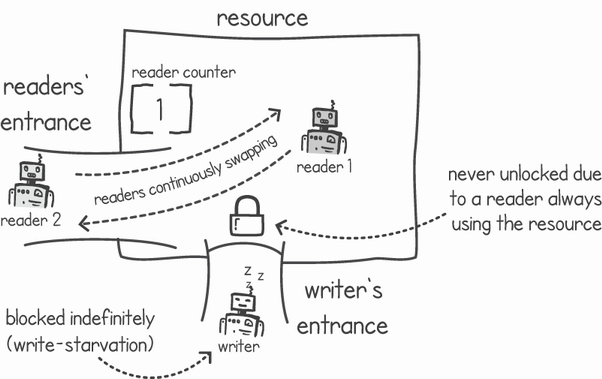
Visualizes readers continuously holding access while the writer remains unable to enter the shared resource. section 5.1.4
Listing 5.11 Write-preferring readers–writer mutex type
package main

import (
    "sync"
)

type ReadWriteMutex struct {
    readersCounter int                                         #1
    writersWaiting int                                         #2
    writerActive   bool                                        #3
    cond           *sync.Cond
}


func NewReadWriteMutex() *ReadWriteMutex {
    return &ReadWriteMutex{cond: sync.NewCond(&sync.Mutex{})}  #4
}
#1 Stores the number of readers currently holding the read lock
#2 Stores the number of writers currently waiting
#3 Indicates if a writer is holding the write lock
#4 Initializes a new ReadWriteMutex with a new condition variable and associated mutex
Shows the state carried by a write-preferring readers–writer mutex: reader count, waiting writers, active writer, and condition variable. section 5.1.4



