A stateless system keeps application state out of web-server memory, allowing requests to reach multiple servers behind a load balancer. Persistent state and business logic move into database operations. section 1.4.1
Statelessness improves deployment flexibility but changes the system’s failure and consistency boundaries:
- Multiple front-end servers can serve requests without synchronizing feature-rich in-memory objects. section 1.4.1
- Database calls can fail because of insertion errors, server crashes, or network problems. section 1.4.1
- Concurrent updates, duplicate records, and multi-table operations require explicit database coordination. section 1.4.1
Starting a conversation
An in-memory Conversation object can add a Message directly. In a stateless design, the same action becomes database work, potentially inserting rows into both Conversation and Message tables. section 1.4.1
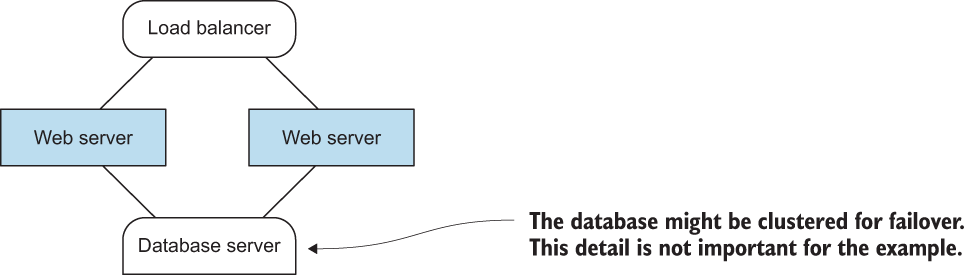
Use the load-balancer diagram to visualize why server-local application state must be removed or externalized. section 1.4.1













