Static storage holds data allocated for the entire execution of a program. In embedded Rust, its size is fixed at compile time, and its contents persist across function calls. It is useful for lookup tables, configuration constants, and global state. section 7.1.1
The linker determines memory placement, and the reset handler initializes .data and .bss before main runs. These sections hold statically allocated variables in RAM; program code is placed in .text in FLASH. Static memory has deterministic access timing, but it consumes resources for the life of the program. section 7.1.1
Static storage differs from the stack, where function frames come and go as functions are called and return. The heap supports runtime allocation, but in no_std Rust it is not available by default: using it requires alloc, a global allocator, and reserved RAM. section 7.1.1 section 7.5
Fixed capacity is not necessarily static
A local array such as let mut buf: [u8; 32] = [0; 32] provides fixed-capacity storage without a heap. As a local variable, however, it belongs to the function’s stack frame rather than persistent static storage. section 1.3.1 section 7.1.1
Figure 7.1 Memory regions of an embedded Rust program
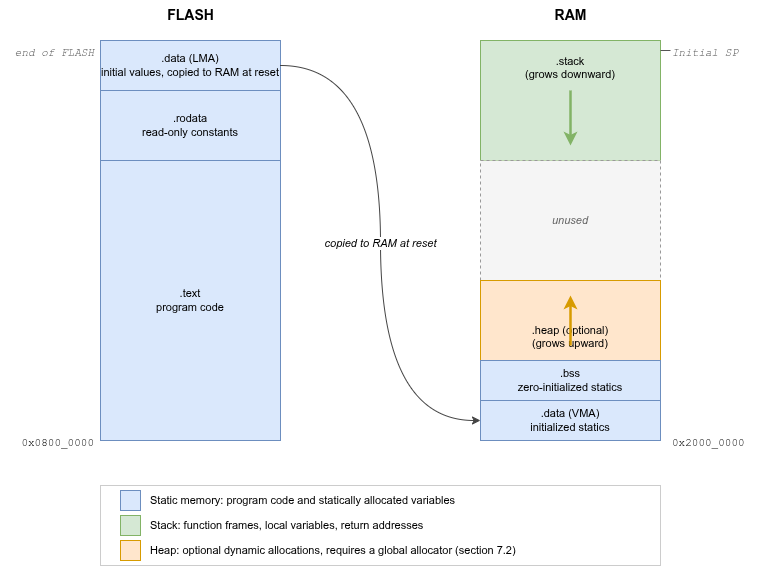
Compare static memory with the stack and optional heap in an embedded Rust address space. section 7.1.1


