A stock share price is the monetary value assigned to one share of a company’s equity. In a priced financing round, calculate it by dividing the valuation by the relevant total number of shares. The price also helps translate ownership percentages into the potential value of a founder’s or employee’s stake. section 10.4 section 20.2.1
A seed-round calculation
Suppose a company has a post-money valuation of $2.5 million and 10 million total shares. Dividing valuation by shares gives a price of 25¢ per share. Later, a higher share price can increase the value of an existing stake even when new shares dilute its ownership percentage. section 10.4 section 20.2.1
Read the share price alongside the financing outcome:
- Track whether the price rises, stays flat, or falls between financing rounds; a flat or down round can reduce both ownership percentage and stake value. section 20.2.1
- Check the share class as well as the price: preferred shares may receive payment before common shares during a low-value liquidation or acquisition. section 10.4
- Distinguish an equity sale from an asset sale; an equity sale typically offers a share price for the company and purchases its shares. section 31.1.1
Figure 10.1 Pre- and post-money valuations for a sample seed and Series A. Values are in millions, except price per share.
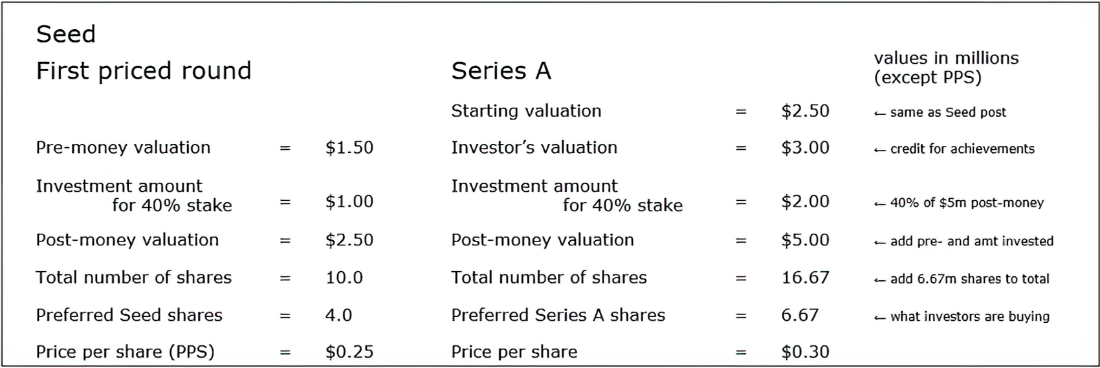
Compare sample seed and Series A valuations, share counts, and prices per share in one figure. section 10.4

