A strangler fig grows around a host tree until the original tree is no longer needed. The strangler pattern applies the same idea to software: build a replacement around a legacy system, move functionality into it gradually, and retire the old system when it is no longer needed. section 5.7 section 12.5.1
The alternative is a big-bang rewrite: stop delivering features while the team rebuilds everything. A gradual migration lets the business keep moving while individual pieces are replaced. It is not free, though: new boundaries add complexity, and splitting a monolith across a network affects speed and reliability. section 12.5 section 5.7.1 section 12.5.2
One way to start is with a hexagonal outpost:
- Find a seam: choose an isolatable feature or bug-fix area. section 5.7.1
- Build the new logic in a separate hexagonal boundary, defining a port for what it needs. section 5.7 section 5.7.1
- Create an adapter that satisfies the port by calling the legacy code or database. section 5.7.1
- Move more logic into the new boundary over time, until the old host is no longer needed. section 5.7.1
Strangling a shop monolith
A team moves billing into a new service and configures an API gateway to send /billing requests there. The old billing code stops receiving that traffic. The team repeats the move for inventory and shipping; once all routes point to replacements, the legacy server can be shut down. Moving data is a major challenge: change data capture can stream database transaction logs from the old system to the new one. section 12.5.2 section 12.11
Figure 12.4 The Strangler Fig Migration. Instead of a risky "Big Bang" rewrite, an API Gateway incrementally reroutes traffic to the new Microservice, while Change Data Capture (CDC) safely syncs the underlying data in the background.
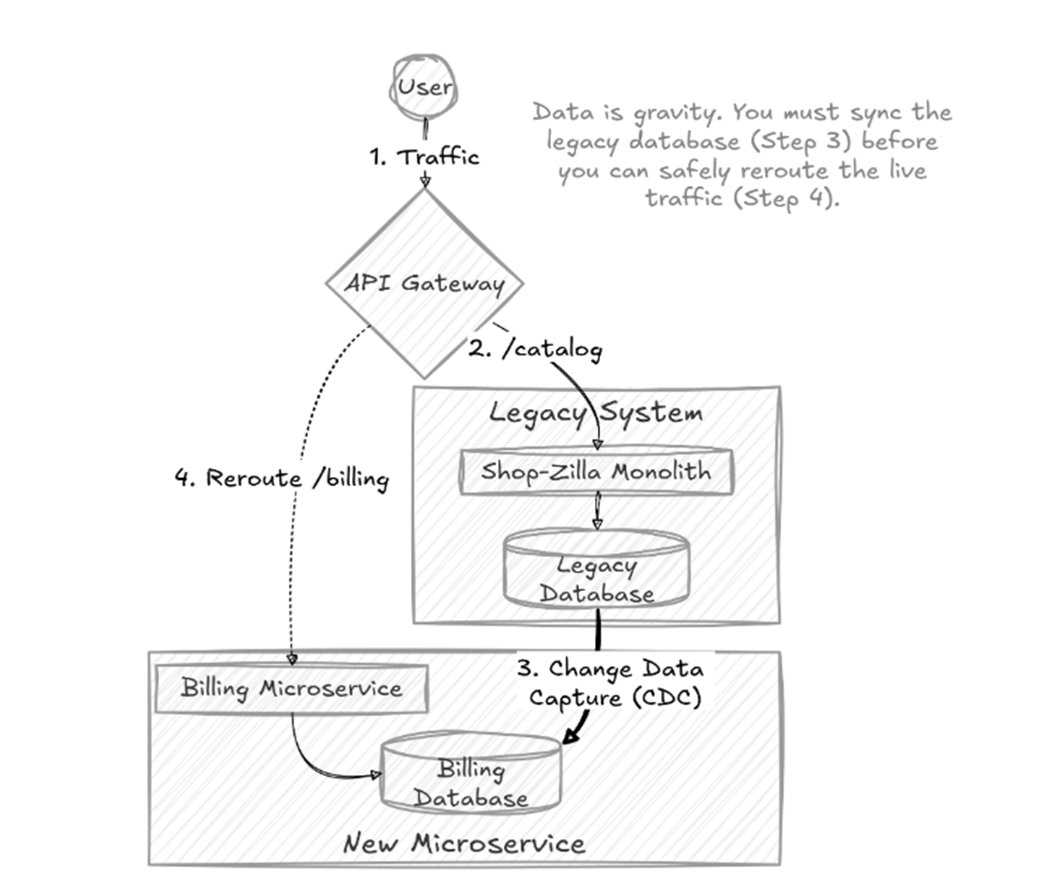
The diagram brings the traffic shift and background data synchronization together in one migration picture. section 12.5.2
Choose a small, isolatable starting point and count the cost of the new boundaries before expanding. Gradual replacement avoids a single disruptive cutover, but it does not make the complexity of migration or distributed services disappear. section 5.7.1 section 12.5.2





