STRIDE is a threat-modeling method for asking what can go wrong in an API or system. It classifies attacker strategies into six practical categories. section 2.2.2
Use the categories to brainstorm potential abuse and failure modes:
- Spoofing: stealing credentials or taking over accounts. section 2.2.2
- Tampering: corrupting data or performing unintended updates. section 2.2.2
- Repudiation: being unable to prove whether a user performed an action. section 2.2.2
- Information disclosure: leaking configuration details or sensitive data. section 2.7
- Denial of service: making the system unavailable. section 2.7
- Elevation of privilege: gaining administrative privileges without authorization. section 2.7
Apply STRIDE during threat identification and ranking by asking how attackers could steal tokens, bypass access controls, access another user’s data, or expose configuration. Team brainstorming helps generate candidates. section 2.2.2
Figure 2.5 Each threat category in STRIDE represents a strategy for breaking into our system or stealing data from our APIs.
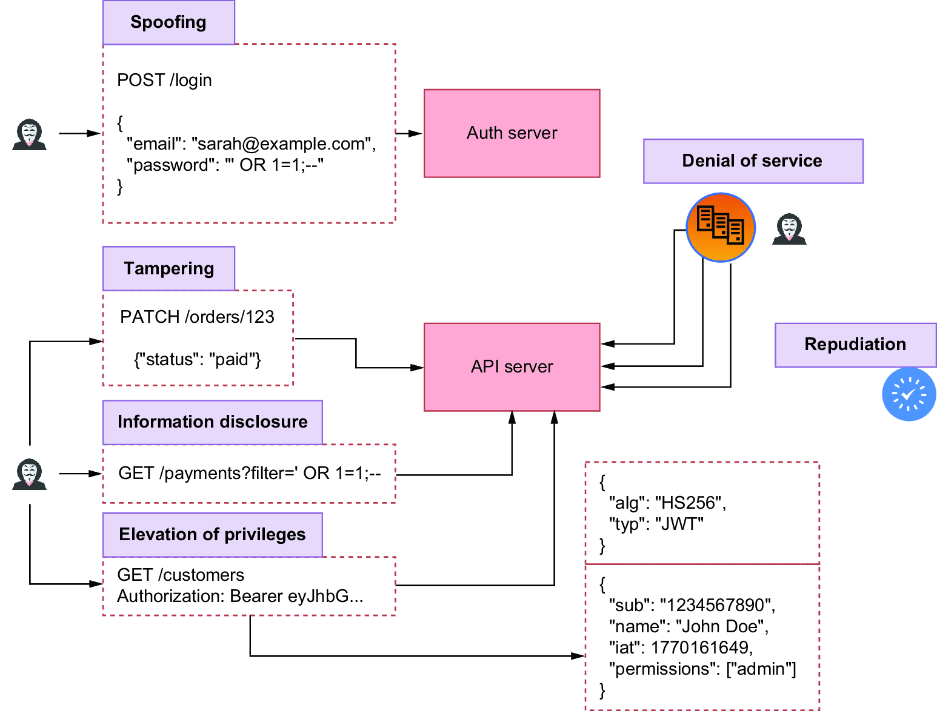
Use the figure as a compact map of the six ways an attacker might break into an API or steal its data. section 2.2.2
