liveBook · Manning

Structural motif

As explained in Graph Algorithms for Data Science

A motif is a distinctly connected subgraph whose occurrence pattern can be counted in a network.

A structural motif is a distinctly connected subgraph whose occurrence pattern can be counted to characterize network structure. section 8.1.1

Motifs and graphlets serve different analytical purposes:

  • A motif counts how often a connected pattern occurs in the network. section 8.1.1
  • A graphlet describes a node’s position within a motif and encodes its local neighborhood. section 8.1.1 section 8.5
  • Motif and graphlet counts can contribute to representations of individual nodes or entire graphs. section 8.1.1

Follower-network patterns

In a follower network, motif 1 contains three nodes and two relationships. Its occurrence is counted once as a motif, while its three possible node positions produce three graphlets. Two-node and selected three-node patterns can be calculated for users and stored as node properties. section 8.1.1
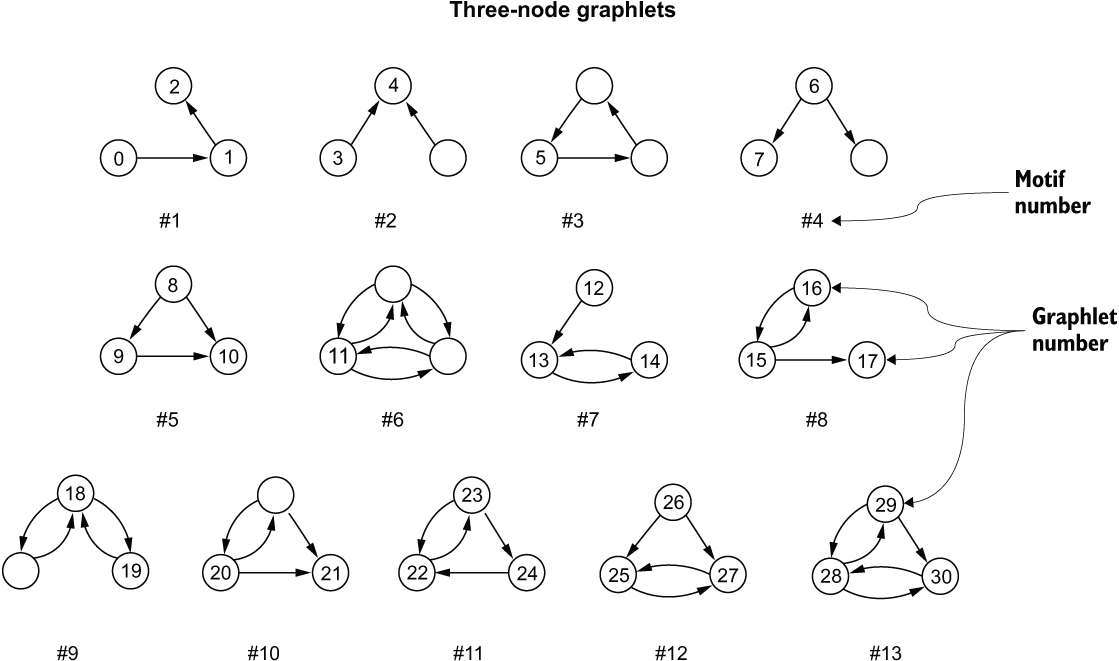
Figure 8.6 Three-node graphlets
08-06

Inspect the three-node graphlet variations used to distinguish network patterns from node positions within those patterns. section 8.1.1

How Graph Algorithms for Data Science covers it

How deep it goes
Defines motifs against graphlets and works through two- and three-node patterns, while stopping short of calculating every variation.
Examples
Uses follower-network counts, motif 1, two-node graphlets, and selected directed three-node graphlets.
What you can do after
Apply it via Cypher by counting network patterns and storing graphlet results as node properties.
How it connects
Connects motifs with graphlets, local neighborhoods, node representations, and whole-graph representations.

Related concepts

This explainer was generated by Manning's knowledge graph from the text of Graph Algorithms for Data Science. The section links point to the parts of the book it draws on.