A sink node, or subscriber, is a component that listens for messages and reacts when they arrive. In publish-subscribe messaging, it expresses interest in one or more topics and receives the messages published to them. section 7.2.3 section 7.2.1
Think of a subscriber as someone waiting for a doorbell, rather than repeatedly checking the door. A producer publishes an event without calling each subscriber directly; a broker sits between them and buffers messages. The producer can move on even when a consumer is offline, but processing happens later, so results may not be immediately consistent. section 7.2.1 section 7.9
One order, several reactions
An Order Service publishes OrderPlaced. A Shipping Service subscribes and prints a label; Rewards and Analytics subscribers add points and update a dashboard. The latter services can be added without changing the Order Service. section 7.2.3
Figure 7.5 Open/Closed Principle in action: We can add the Rewards and Analytics services without ever touching the code in the Order Service
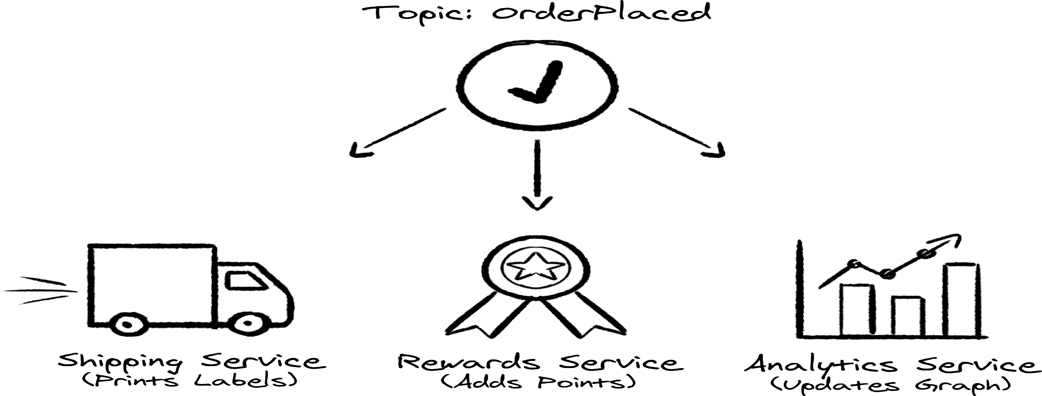
The diagram shows how additional subscribers can react to an order without changes to the publisher. section 7.2.3
Subscribers need to handle the realities of asynchronous delivery:
- Ordering: Events may arrive out of order across partitions. Use a suitable partition key and make consumers able to handle out-of-order events. section 7.4.2
- Duplicates: With at-least-once delivery, retries can deliver the same event twice. An idempotent consumer can track processed event IDs and treat duplicates as no-ops. section 7.4.2
- Failures: Acknowledgments support delivery, while a monitored dead letter queue catches messages that would otherwise repeatedly crash consumers. section 7.9
A slow worker
An AI agent can subscribe to TicketCreated, send the ticket to a language model asynchronously, save a draft, and publish TicketDrafted. The user need not wait for the analysis to finish. section 7.3.4