In a reactive task flow, a subscriber is the consuming end of a dependency: it attaches to another task’s producer and consumes that task’s result when it finishes. Tasks declare these dependencies instead of keeping a thread waiting during I/O. section 11.4
WebClient request chain
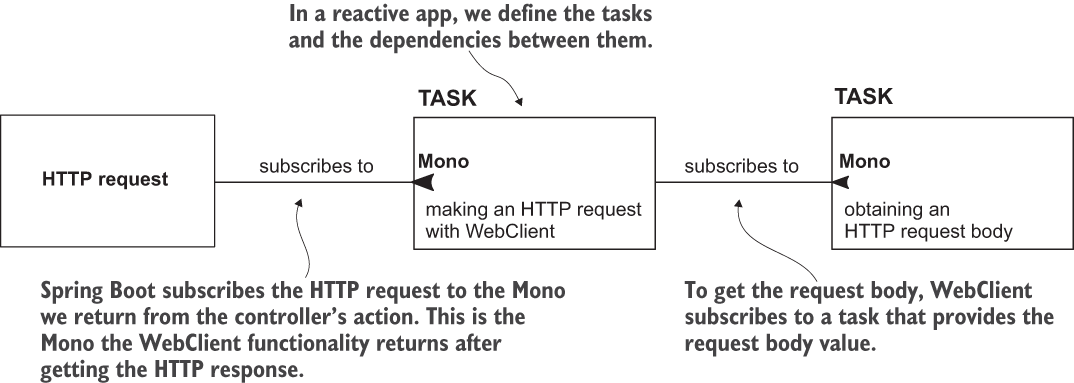
WebFlux subscribes to the producer returned by the controller’s action. WebClient, in turn, subscribes to a task that supplies the request body. section 11.4
Figure 11.10 The tasks chain in a reactive app. When building a reactive web app, we define the tasks and the dependencies between them. The WebFlux functionality, initiating the HTTP request, subscribes to the task we create through the producer the controller’s action returns. In our case, this producer is the one we get by sending the HTTP request with WebClient. For WebClient to make the request, it subscribes to another task that provides the request body.
Follow the subscriptions from the controller’s returned producer to the task supplying the request body. section 11.4