A superconducting circuit is a quantum-computing platform that implements quantum states with electrical circuits containing superconducting elements. It is one of the main hardware technologies pursued alongside trapped ions, neutral atoms, and photons. Current devices belong to the noisy intermediate-scale quantum era: they are large enough to challenge classical simulation in some demonstrations, yet too small and noisy for practical problems. section 1.3.2
Figure 1.2 The major milestones of quantum hardware development. The first two, showing the use of quantum mechanics to perform a computation and having a quantum computer solve an artificial problem that a classical computer cannot, have already been achieved. The next milestone, building a fault-tolerant quantum computer that can run long computations, is the current focus. The final goal is to build a quantum computer that can solve practical problems that a classical computer cannot.
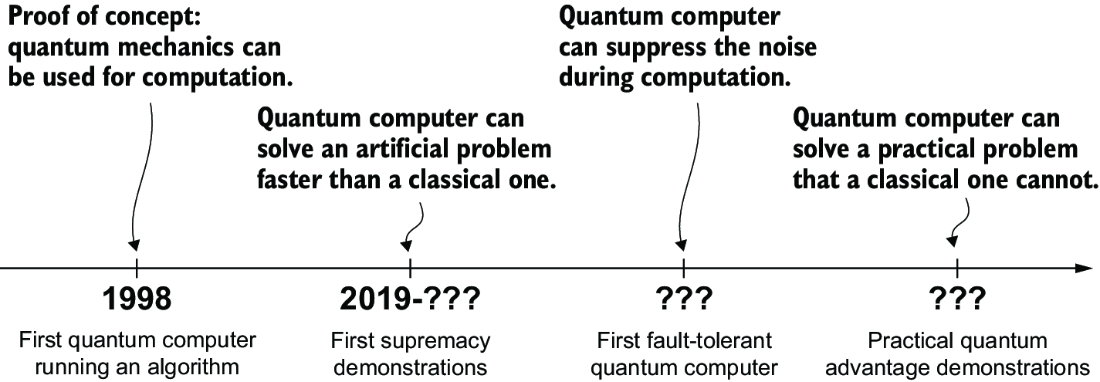
The hardware-development milestones place superconducting circuits within the progression from proof-of-concept demonstrations and artificial computational advantages toward fault-tolerant machines and useful applications. section 1.3.2
