A trapped-ion platform encodes each qubit in the quantum state of an ion confined by electromagnetic fields. It is one of the principal hardware approaches pursued for quantum computers, alongside superconducting circuits, neutral atoms, and photons. section 1.3.2
A trapped-ion system connects hardware, control, and testing layers:
- Platform-specific control software operates the lasers applied to the ions. section 1.3.3
- Middle-layer software maps abstract qubits and logical gates onto physical qubits and hardware operations. section 1.3.3
- Quantum simulators can test small programs or imitate noisy device behavior before execution on hardware. section 1.3.3
Figure 1.2 The major milestones of quantum hardware development. The first two, showing the use of quantum mechanics to perform a computation and having a quantum computer solve an artificial problem that a classical computer cannot, have already been achieved. The next milestone, building a fault-tolerant quantum computer that can run long computations, is the current focus. The final goal is to build a quantum computer that can solve practical problems that a classical computer cannot.
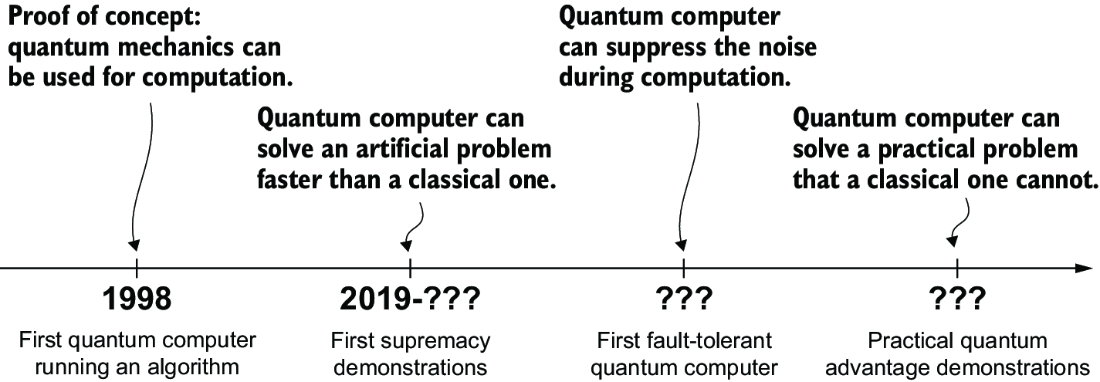
Use the hardware milestones to place trapped-ion platforms within the progression from proof-of-concept devices toward fault-tolerant and practically useful quantum computers. section 1.3.2
Figure 1.3 A quantum software stack serves as an interface between the quantum algorithms and the hardware running them. Its components mirror those of the classical software stack.
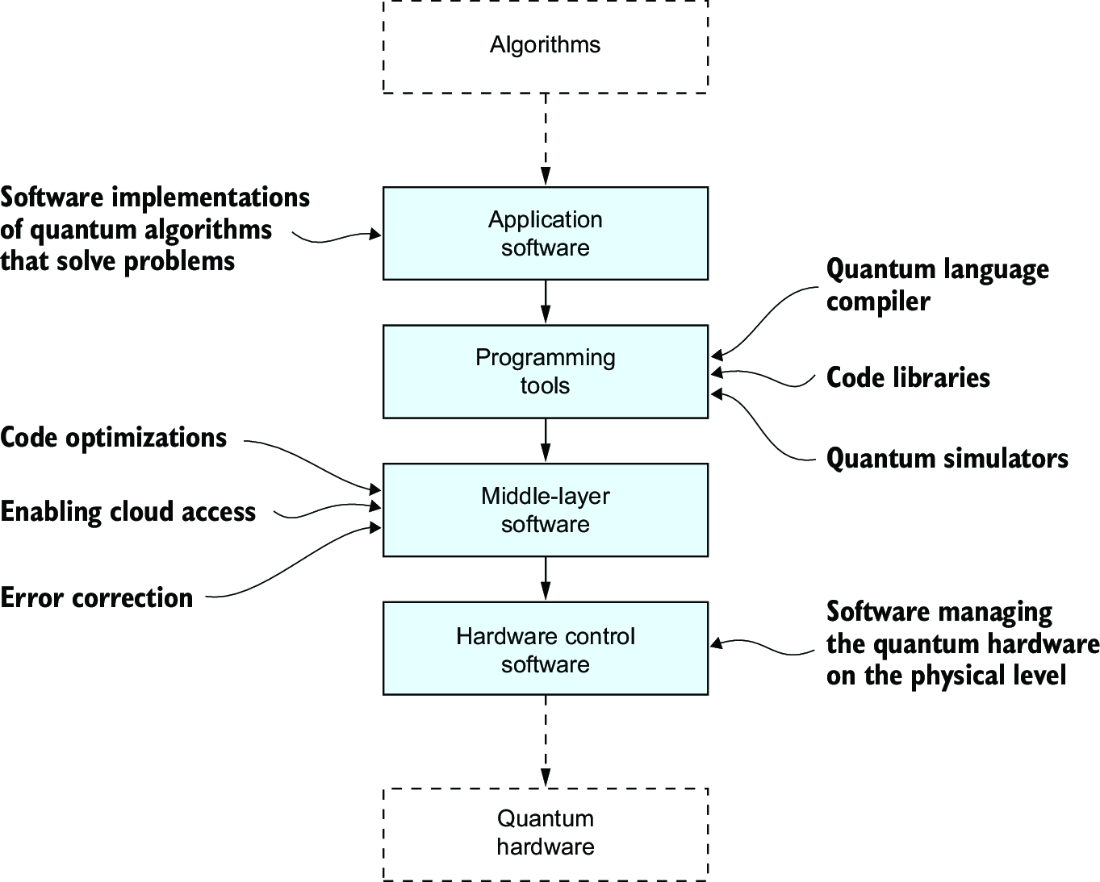
Use the software-stack view to trace how abstract quantum algorithms reach trapped-ion hardware through mapping, compilation, and laser control. section 1.3.3
