A support vector is a training observation that lies on a margin boundary of a maximum-margin classifier. In a hard-margin SVM, the condition is yᵢ(wᵀxᵢ + b) = 1, where yᵢ is the class label and wᵀxᵢ + b defines the decision boundary. section 8.2.2
These observations constrain the margin’s width and determine the boundary’s position. Moving a support vector may change the fitted boundary; sufficiently distant training observations do not directly determine it. section 8.2.2
The same idea appears algebraically in the fitted weight vector: w = ∑ᵢ αᵢyᵢxᵢ. A training observation is a support vector when its coefficient αᵢ is positive; observations with zero coefficients contribute nothing. section 8.5.1
A threshold between safe and unsafe readings
For temperature readings separated by a threshold, the nearest safe and unsafe observations are support vectors. Placing the threshold midway between them maximizes the margin. section 8.1.1
Figure 8.1 Temperature readings appear along a single horizontal axis, increasing from left to right. Circles represent safe conditions, and squares represent unsafe conditions. The vertical dashed line is the decision boundary. The nearest observation on each side is a support vector, and the distance between the boundary and these points defines the margin on either side. Positioning the boundary midway between the support vectors produces the maximum-margin separator.
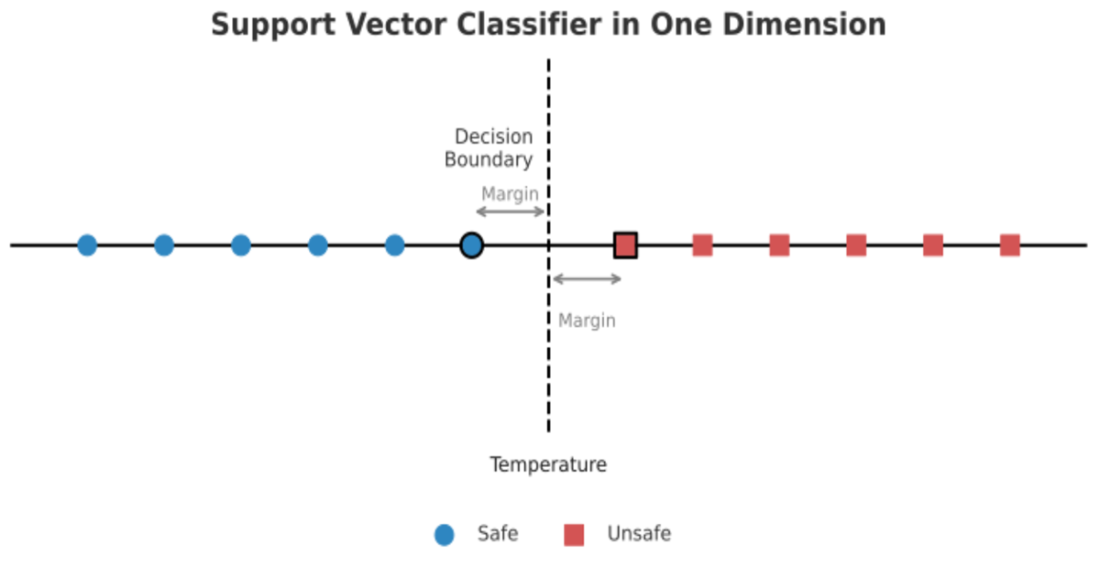
The diagram shows how the nearest observations anchor the decision boundary and define the margin. section 8.1.1

