A support vector machine (SVM) is a supervised classification model that chooses a decision boundary with maximum margin. It minimizes the parameter vector’s L2 norm while requiring every training example to be correctly classified. section 5.3 section 5.8
As the norm decreases, the margin expands until further movement would violate the classification constraints. Points on the margin boundaries become support vectors, and these points suffice to determine the learned parameters. section 5.3
The optimization can be developed in several connected steps:
- Formulate the primal problem as minimizing the parameter norm subject to correct-classification constraints. section 5.3
- Construct the dual using a Lagrangian with nonnegative multipliers, turning the primal minimization into a maximization problem. section 5.3
- Use pairwise inner products between training vectors in the dual formulation, then generalize those similarities with a kernel function. section 5.3
- Implement configurable parameters such as C, the kernel, its power, and gamma, while storing multipliers, support vectors, labels, and the intercept. section 5.3
Kernel implementation
A radial-basis-function kernel computes the squared Euclidean distance between two vectors and returns exp(-gamma times that distance), providing a nonlinear similarity measure without explicitly representing transformed features. section 5.3
Figure 5.8 Max margin solution of SVM classifier
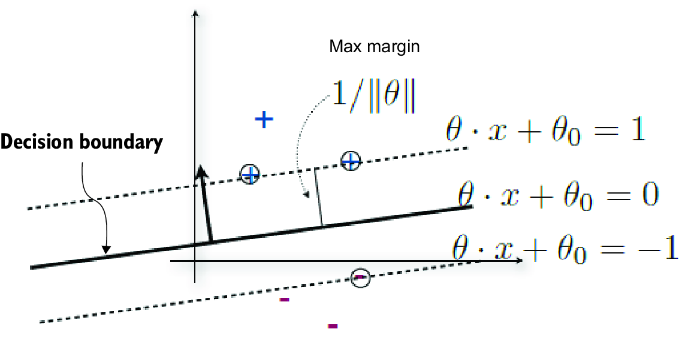
Use the maximum-margin diagram to inspect how the decision boundary, margin boundaries, and support vectors relate geometrically. section 5.3
Figure 5.9 Support vector machine pseudo-code
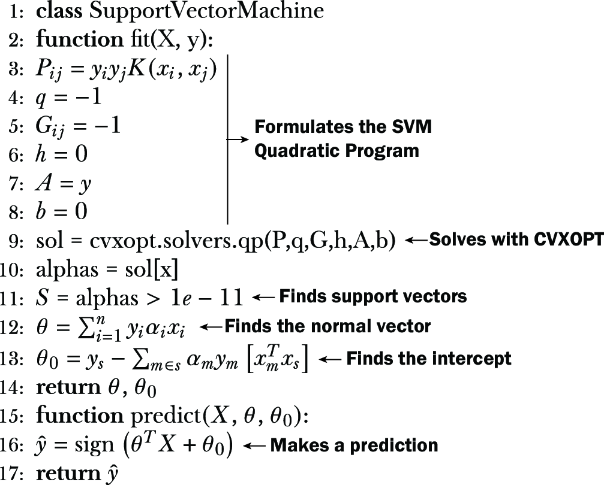
Use the pseudo-code as a compact navigation aid for the SVM training procedure. section 5.3




