liveBook · Manning

Supporting subdomain

As explained in Microservices Patterns, Second Edition

A supporting subdomain contains business logic that is common across businesses but requires organization-specific customization.

A supporting subdomain contains business logic common across businesses that requires organization-specific customization. In a microservice architecture, separating subdomains with different characteristics can improve development, scalability, availability, or security. section 7.4.5

Order management and fraud detection

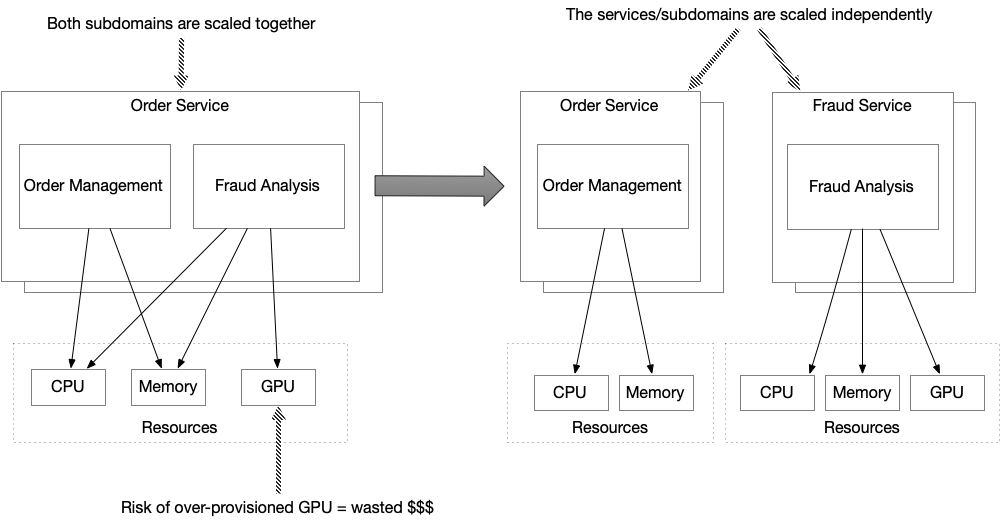
Order Management needs ten instances, while GPU-based Fraud Detection needs five. Packaging both in one Order Service requires ten instances, leaving half the Fraud Detection capacity underused. Separate services can scale independently. section 7.4.5

Figure 7.7 Subdomains within the same service are scaled together, which can require over-provisioning of some resources. Putting them in separate services enables them to be scaled independently which improves resource utilization and reduces cost.
segregate by resources

Illustrates how separating subdomains avoids scaling them together and can reduce resource over-provisioning. section 7.4.5


How Microservices Patterns, Second Edition covers it

How deep it goes
Explains resource-based scaling with an enterprise example, without detailing implementation beyond independent service scaling.
Examples
Contrasts ten Order Management instances with five GPU-based Fraud Detection instances to show the cost of scaling them together.
What you can do after
Evaluate whether separating subdomains can avoid over-provisioning and enable independent scaling.
How it connects
Connects supporting subdomains to domain-driven design and microservice architecture.

Also explained in

Compare how 2 books explain supporting subdomain →

Related concepts

This explainer was generated by Manning's knowledge graph from the text of Microservices Patterns, Second Edition. The section links point to the parts of the book it draws on.