A supportive work environment helps people share goals, challenges, and ideas without fear of judgment. It rests on trust, empathy, reliability, mutual respect, collaboration, and inclusion. section 9.2 section 12.1.3
Build this environment through practical behaviors:
- Listen empathetically, remain nonjudgmental, and make confidentiality expectations clear. section 9.2
- Stay accessible and reliable; give early notice when plans change and use email or chat when meetings must be rescheduled. section 9.2
- Invite diverse perspectives, support inclusion initiatives, and examine language and practices that may exclude people. section 12.1.3
- Help colleagues succeed rather than operating as a lone specialist; collaboration improves knowledge sharing, cohesion, and problem-solving. section 9.2 section 12.1.3
Everyday support
A mentor tells mentees that conversations are confidential and nonjudgmental. When a meeting must be postponed, the mentor gives advance notice and offers email or chat instead. These small actions signal continued investment and make guidance easier to seek. section 9.2
Inclusion in practice
Technology teams can test whose perspectives are missing by examining outcomes such as facial-recognition failures for dark-skinned individuals and by replacing exclusionary terminology with more neutral alternatives. section 12.1.3
Figure 12.2 How to cultivate a positive working environment
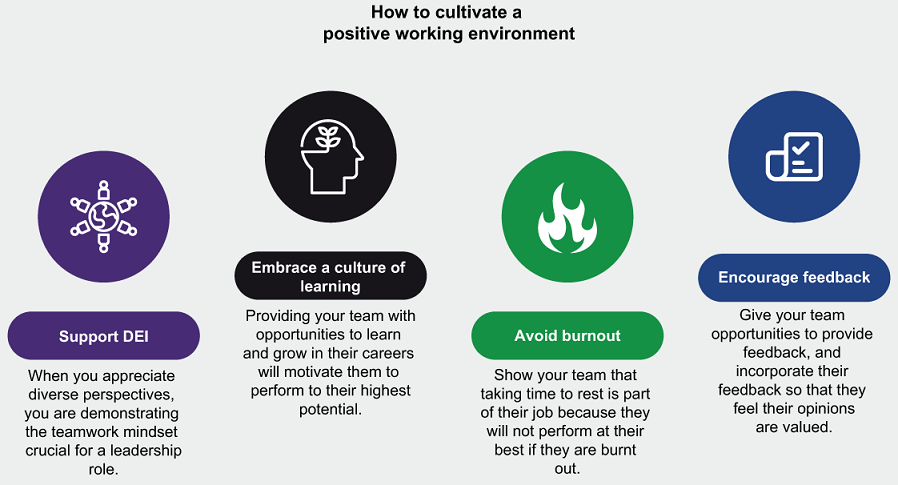
Use the visual checklist to review behaviors that cultivate a positive working environment. section 12.1.3

