Sustainable software minimizes unnecessary use of computation, memory, storage, network bandwidth, and hardware. Its aim is practical as well as environmental: wasteful resource use raises operating cost, electricity demand, and infrastructure needs. The guiding question is not whether code merely works, reads well, or runs quickly, but whether it delivers an acceptable result with the smallest reasonable resource footprint. section 1.1.6 section 8.2.2 section 8.3
Sustainability complements rather than replaces clean code and performance. Clean code favors readability and maintainability; performance favors speed and responsiveness. Neither alone guarantees low impact. Efficiency joins sustainability and performance by setting an acceptable responsiveness level, then meeting it with minimal hardware resources. The broader craft goal is maintainable, efficient code that avoids unnecessary cost and environmental footprint. section 8.3
Figure 8.1 How sustainable coding fits with clean code and performance
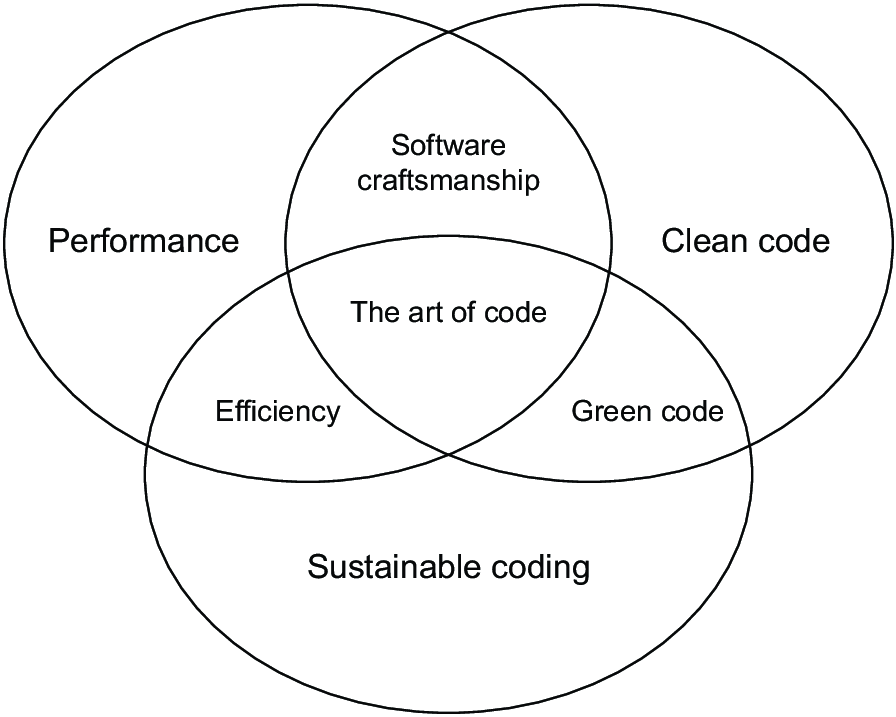
Compare sustainability with clean code and performance: sustainability focuses on impact, while efficiency is their practical overlap with performance. section 8.3
Make sustainable coding an everyday engineering practice by seeking actionable feedback:
- Estimate a web page’s client-side footprint from page weight, request count, and DOM complexity with web-focused tools. section 8.5.2
- Use static analysis to flag resource-wasting patterns; distinguish it from dynamic analysis, which observes running software and can measure energy-related behavior. section 8.5.2
- Measure small alternatives with microbenchmarks and investigate CPU behavior and memory allocation with profilers. section 8.5.2
- Treat tool feedback like IDE, test, and code-quality feedback so resource awareness becomes part of normal development work. section 8.5
Reduce a people-analysis routine’s memory footprint
When finding the youngest and oldest people and sorting names, a memory-conscious imperative variant replaces nullable boxed Integer values with primitive int sentinels and preallocates the names list to the input size. These changes avoid temporary boxed objects and reduce avoidable allocation. Functional stream pipelines may also create short-lived objects at each stage; consolidating work into one pipeline is presented as a resource-saving alternative, with tradeoffs in implementation complexity. section 10.2.2
Resource savings also affect hardware lifetime. Because device manufacturing accounts for much of a device’s carbon impact, unnecessary replacement increases environmental debt. Reducing electricity and infrastructure use while extending hardware lifespans therefore has a direct financial case alongside its environmental one. section 8.2.2
