A symbol of power is a culturally meaningful behavior, characteristic, practice, or artifact that signals status, authority, or influence within a group. It can reveal implicit rank: influence granted socially rather than assigned by an organizational hierarchy. In collaborative modeling, overlooking such signals can let an apparently lower-ranked participant redirect discussion, challenge formal leaders, or shape what the group considers safe to say. section 6.3.1
Look for symbols before facilitating, not only for job titles. Participatory observation examines culture from within through the emic perspective—the lived experience of participants—and then forms an outsider’s etic interpretation from collected stories. Fear of writing a wrong domain event, for example, may lead people to wait for someone else’s example; that hesitation can expose a power dynamic rather than a lack of knowledge. section 6.3.1
Use observed symbols to prepare a safer, more inclusive session:
- Collect anecdotes, behaviors, and reactions that indicate who is deferred to, who can challenge others, and who hesitates to contribute. section 6.3.1
- Interview people before cross-organizational modeling to identify symbols that may determine implicit ranking. section 6.5
- Establish collaboratively agreed safety rules when working agreements are unclear, so the group can refer to them when conduct becomes unsafe. section 6.3.2
- Adjust facilitation deliberately: begin more passively, then become more active; welcome participants personally when holding high rank; and share power so others can speak. section 6.3.2 section 6.5
When formal authority is not the only authority
During a Big Picture EventStorming session, conflict arose because some people recorded current-state domain events while others wrote desired future events. A participant who did not appear explicitly high in rank led opposition to the head of engineering and gained support. The group had missed the organization’s symbols of power, so an implicit leader influenced the session without being recognized as such. section 6.3.1
Symbols of power are not fixed. Rank shifts with communication style, nonverbal behavior, and what a culture recognizes as influential. Self-steering teams still need clear, inclusive ways to make decisions; otherwise, the strongest or most influential people may dominate, making the environment less safe and equal. section 6.3.2
Figure 6.3 An example map of how to model the organization and capture symbols, anecdotes, and our own thoughts. In reality, this would be a lot bigger, so we like to use online tools where we can easily enlarge the area and collaborate on capturing our observations.
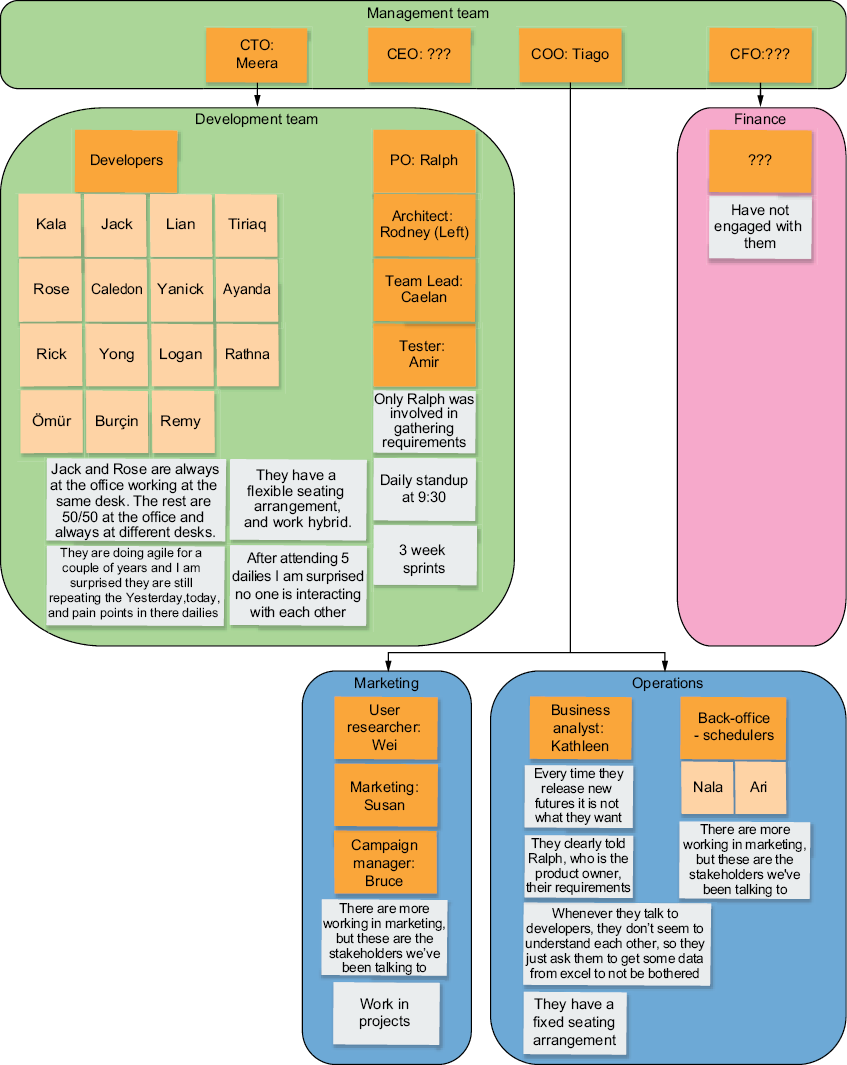
Use this organization map to capture symbols, anecdotes, and facilitator observations together, then discuss how they may shape participation and implicit rank. section 6.3.1
